Public numbers for commercial plumbing are thin, and anyone who names an exact Temecula hourly rate without seeing your building is guessing. One older national guide put commercial work at about $100 an hour against about $80 for residential. Treat that as a starting point for thinking, not a price. If you run a shop, restaurant, winery or office, start at the commercial plumbing page.
What does a commercial plumber charge per hour?
The single commercial figure in a 2023 national guide was about $100 an hour, against about $80 for residential work. Those numbers are national, a few years old and say nothing specific about Temecula, so use them only to gauge scale. A real quote depends on the building, the work and the time of day.
Wages and billing rates are not the same thing. As of May 2025, median pay for plumbers, pipefitters and steamfitters was $30.67 an hour according to the Bureau of Labor Statistics, and that is what the worker takes home. A business's billing rate must also pay for insurance, vehicles, tools, supplies, permits and the office, so it runs far above the wage and the two cannot be compared directly.
Master and journeyman are separate license steps in many trades, and a business may price them differently. Ask which of them is coming to the site and how that person's time is charged.
What billing methods exist apart from an hourly rate?
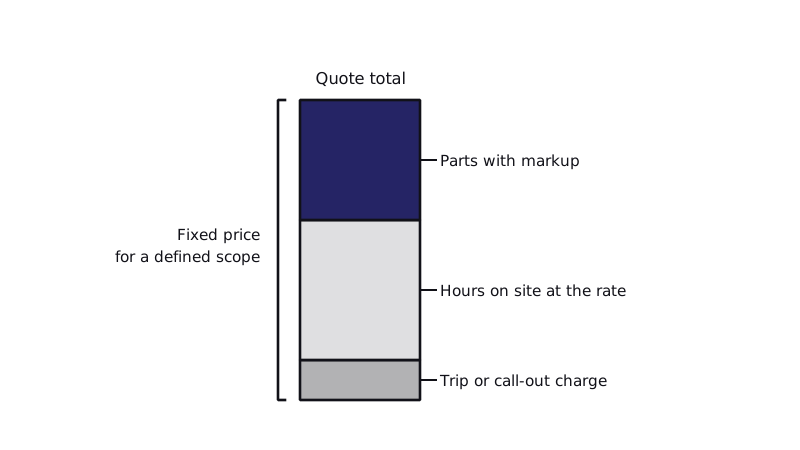
Most businesses mix several elements: a trip or call-out fee, an hourly charge for time on site, a markup on parts and materials, and a set price for defined work such as a backflow test, a water heater swap or a grease trap cleanout. Large projects are bid at a fixed price against a scope sheet, and maintenance contracts are a further option.
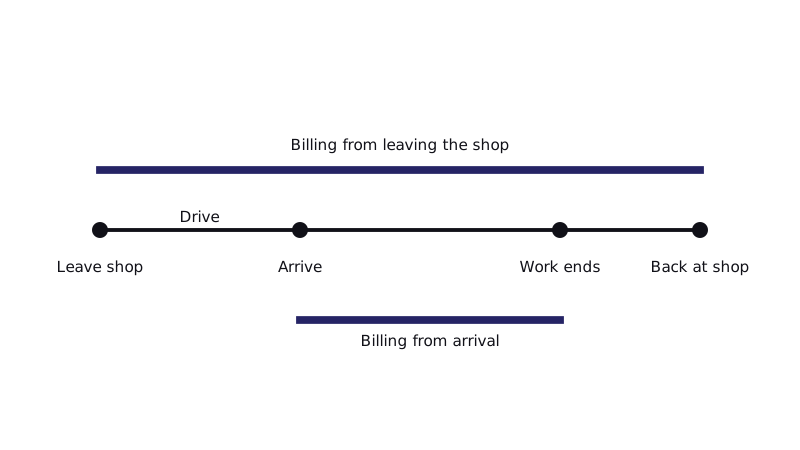
The clock starts and stops at different points. Some businesses count from leaving the shop, others from arrival. Minimum charges of one or two hours are common. Read the terms before any work begins.
Parts are rarely sold at cost, and commercial fixtures like flush valves, floor drains and commercial water heaters cost more than their residential counterparts. Check whether the quote includes materials, hauling away the old equipment and any permit fees, and get line items in writing.
Why is emergency or after-hours work pricier?
The business pays crews to stay reachable and often pays overtime. Businesses commonly charge a premium over the standard rate, plus a separate dispatch fee, and the multiplier differs from one company to the next. Pin down the multiplier and the trip charge before agreeing to the visit.
For a restaurant with a flooded kitchen or a shop with a broken main, losing a day of business can outweigh the premium. Both sides are protected by a written scope and a phone confirmation of the rate before dispatch.
A night visit cannot be promised, as the hours posted here are Monday to Friday, 9am to 5pm. When water is pouring in, shut the building's main shutoff first, then send a request so that it is in the queue as the day begins. The burst pipe emergency page covers floods.
What drives commercial plumbing prices in Temecula?
Building age and type, access, the trade involved and compliance work. Old Town storefronts have older pipe and tight spaces, hospitality properties such as the resort near Pechanga have large systems and heavy fixture loads, wineries may run septic or well systems, and offices in newer parks are easier to reach. Backflow devices, grease and sampling rules can add required work.
Permits and inspections are split the way they are for homes. City of Temecula Building and Safety handles the city, Riverside County covers unincorporated areas, and Fallbrook and Rainbow fall under San Diego County. Commercial jobs often require plans, and some need fire or health sign-off, which takes extra time.
Hard water is a recurring local cost. Rancho Water's reports put average hardness around 230 to 240 mg/L in the 2020 to 2023 editions, so scale in commercial water heaters, ice machines and dishwashers is a reason to budget for flushing and descaling.
What is a fair way to compare commercial quotes?
Ask every business the same four things: the rate and the minimum, the trip charge, whether parts are marked up, and whether the price is fixed or time and materials. Then compare the total for an identical scope, not the hourly rates by themselves. A higher rate with a faster, correct fix can cost less than a cheap rate that needs a return visit.
Look up the contractor's license number on the state contractors board website and ask for proof of insurance. Under California rules, jobs of $1,000 or more in labor and materials, and any job requiring a permit, need a contractor license. For recurring needs such as testing, read backflow testing for commercial properties.
Residential plumber costs has its own page, and the guide to plumber hourly rates goes deeper. The main page lists all the other services.
Common questions
Is commercial plumbing more expensive than home plumbing?
Usually, yes. Commercial systems are bigger, fixtures and parts cost more, access can be harder, and codes, permits and insurance rules add overhead. One national guide put commercial work about $20 an hour over residential. Local rates differ, so ask each business to price your particular job and put it in writing.
Do commercial plumbers set a minimum charge?
Many do, commonly one or two hours of labor, and many add a trip charge on top. Some credit the trip charge when you approve the repair. Ask before you book. Getting a written quote means no surprises at the end of a short job.
Who pays for plumbing repairs, tenant or landlord?
The lease decides. Commercial leases often give interior plumbing to the tenant and the structure or mains to the landlord, but the wording differs. Read your lease, tell the landlord about a problem promptly and keep invoices. This site cannot interpret a lease; a lawyer can.
Can I get a flat price rather than an hourly rate?
Often you can for defined jobs like replacing a water heater, a floor drain, a backflow device or a fixture. Open-ended troubleshooting is normally hourly. Request a fixed price with the scope written out, and settle in advance what happens when the plumber finds something unexpected after walls or floors are opened.
Updated