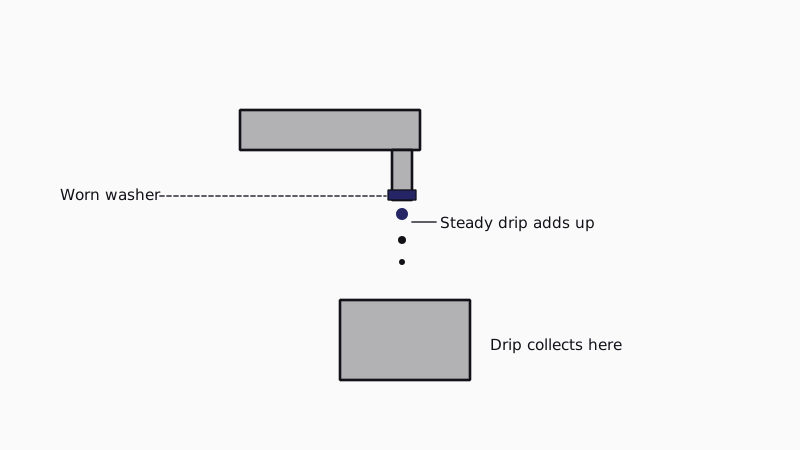
A leaky faucet can raise a water bill, but a slow drip rarely explains a big jump. The extra water is real and it runs all day, though a steady drip typically adds up to only a few hundred gallons over twelve months. A running stream, a leaking toilet or a pipe leak is far more costly. For fixture repairs, see the page on faucet, sink and disposal plumbing.
What volume does a dripping faucet waste?
One drip every second wastes roughly 1 gallon a day, assuming about 20 drops to a milliliter, which comes to around 400 gallons a year. The figure moves with drop size and speed, so treat it as an estimate. A thin steady trickle wastes several times that.
Here is the arithmetic so you can check it. One drip a second is 86,400 drops a day. At 20 drops per milliliter that is about 4.3 liters, or just over a gallon. Over a year it comes to about 415 gallons. If the drip becomes a pencil-lead stream, the number can be many times larger, because the flow is continuous and the stream is bigger than the drops.
Per the EPA, the leaks found in a typical household can add up to more than 9,300 gallons annually. A single dripping tap makes up only a sliver. Toilets, irrigation and hidden lines usually account for the larger portions. A hot-water drip also wastes the energy used to heat that water, which is a second cost on top of the bill.
What else pushes a water bill up?
After a sharp rise in the bill, look first at a running toilet, a misbehaving irrigation timer or a leaking sprinkler line, a pool or fountain fill, a leak in the service line or beneath the slab, and genuine changes such as guests, a new fixture or hot weather. A faucet is rarely the main cause.
Check these in order:
- Irrigation. Temecula yards run on timers, and a stuck valve or broken head can run for hours. Watch a zone run, and check for soggy patches.
- Toilets. Tank water may seep into the bowl without a sound, and only a dye test exposes it. The page on why toilets keep running shows how.
- Water heater and softener. A leaking relief valve or a regenerating softener adds flow.
- Under-slab or buried lines. These show up as a meter that keeps moving when everything is off, and sometimes as a floor spot that feels warm.
- Usage changes. More people, a new pool or a hot spell. Compare the same season last year.
For more bill causes, see why water bills run high.
How do I read my meter to see if there is a leak?
Close every tap, appliance and irrigation zone, then look at the meter. A small leak indicator, often a triangle or a dial, sits on most meters and spins whenever water moves. If the dial keeps turning while everything is off, water is escaping somewhere. Write down the reading, leave the water alone for an hour, then check it again.
The meter box normally sits near the curb or property line. Lift the lid carefully, because insects like those spaces, and wipe the face clean. Many water districts count usage in 748-gallon units, so a swing of one or two units is minor while ten or more deserves a hunt. See how your own district prints it.
Two water districts serve the Temecula area, Eastern Municipal Water District and Rancho California Water District, and your bill carries the name of yours. If the meter test says there is a leak and the house side is dry, call your district, because some offer leak-check help.
Can I repair a dripping faucet myself?
Close the shutoff valves beneath the sink, plug the drain so nothing falls in, and remove the handle to reach the worn part. A spout that drips normally has a tired washer, cartridge or valve seat, while water at the base or the handle usually points to an O-ring. Fit an exact-match replacement, put it back together and test.
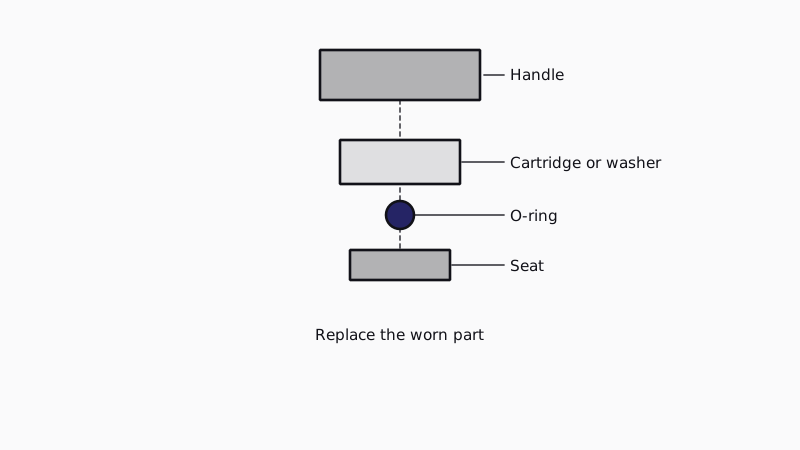
The parts differ by faucet type:
- Compression faucets (two handles, older): replace the rubber washer and check the seat.
- Cartridge faucets: replace the cartridge. Note the brand stamped on it before you buy.
- Ball and ceramic disk faucets: replace the seals or the cartridge as a kit.
Mineral crust builds up on seats and cartridges in hard water. Rancho California Water District's reports put average hardness around 230 to 240 mg/L, so a faucet that drips again after a repair may need the seat cleaned. If the job feels beyond you, the step-by-step leaky faucet repair page guides you through each stage, and a plumber can finish it fast. The quote page is here.
What about a leaking shower, tub or garbage disposal?
A dripping shower valve can waste more than a kitchen faucet because it runs hot water and is often hidden behind a wall. A leaking garbage disposal appears as a wet cabinet, with water coming from the unit's body, the dishwasher hose or the sink flange. Each one is a fixed, findable leak.
Shower and tub faucets: a spout that keeps dripping after you shut the water off has a worn cartridge or seat in the valve. Fix it soon, because hot water that runs into the drain is energy and water together. For double-handle shower valves, the page on how to fix leaky shower faucets covers it.
Disposals: wipe the underside dry, run water and feel along the drain connection, the dishwasher hose connection and the flange. A leak at the body is a dead unit. Replacement involves a mounting ring and a drain connection, and the connection to a dishwasher has its own step, covered on the disposal and dishwasher connection page.
When does a plumber become the right call?
Phone one if the meter still runs with all fixtures closed and you cannot find the source, if a wall or ceiling is damp, if the repair fails repeatedly, or if the valve beneath the sink will not close. Such jobs call for tools, shutoffs and sometimes permits that are poor candidates for guesswork.
Houses with old galvanized or thin copper lines tend to see leaks return, and the right fix is bigger than a washer. Hidden leaks under a slab are a separate trade skill and often need leak detection first. Send a short description through the quote page, and mention what you already tested.
Common questions
What quantity of water does a leaking faucet lose each day?
A steady drip of one drop a second wastes about a gallon a day on the estimate above, and a thin stream can waste many gallons. The measure that matters is the meter. Catch the drip in a measuring cup for ten minutes to compare with your own faucet.
Will my bill drop once I fix a drip?
It will, but by a small amount if the drip was slow. If your bill rose by a lot, the faucet may only be a small part of it. Fix the faucet, then check the toilet and irrigation, and compare the next two bills against the same season last year.
Is a leaking hot water tap worse than a cold one?
Yes, slightly. You pay for the water and for the gas or electricity that heated it. A hot tap that drips at night also keeps the water heater cycling. Fixing the hot side first makes sense when you have two leaks.
Can a leaking faucet damage the sink or cabinet?
Over time, yes. Water under a sink swells particle board, grows mold and corrodes the supply line and shut-off valves. A slow drip behind the handle, which you cannot see, is the worst version. Check under the sink once a month.
Is a plumber necessary for a dripping faucet?
Not always. Swapping out a cartridge or washer is a routine homeowner job, needing a few basic tools and an hour. Call a plumber when the shut-off valves fail, the faucet is old or unusual, or the drip returns after the parts were already replaced.
The rest of our guides start from plumber across Temecula.
Updated