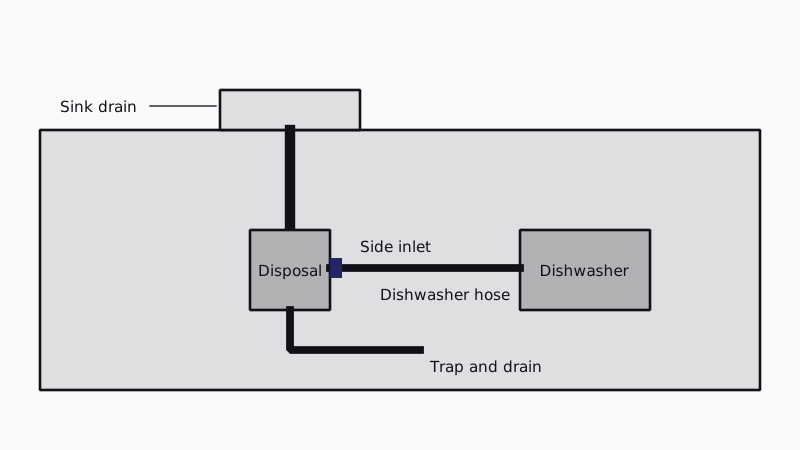
The dishwasher drain hose connects to a small inlet on the side of the disposal. A new disposal arrives with a plastic plug sealing that inlet, and the plug must be knocked out or the dishwasher will not drain. The rest of the work is hanging the unit under the sink flange, joining its discharge to the trap and supplying power. More help is on the disposal repair and fixtures page.
How is the dishwasher joined to the disposal?
The dishwasher's drain hose slides onto the nipple at the disposal's side inlet and is secured with a hose clamp. Before it reaches the disposal, the hose normally climbs into a high loop under the counter, or runs up to an air gap on the sink deck, so that dirty water cannot flow back into the dishwasher.
The knockout plug is the step people miss most. On a new disposal, the dishwasher inlet is sealed by a thin plastic disk. Leave it in place and the dishwasher cannot drain, and you will find standing water in the machine after the first cycle. Take it out before you mount the unit:
- With the disposal unplugged and still out of the sink, set a screwdriver against the plug from the inside and tap it with a hammer so the disk drops into the grinding chamber.
- Reach in, or tip the unit, and remove the disk. Never leave it inside, or it will jam the shredder ring the first time you run the unit.
- Push the dishwasher hose onto the inlet and tighten the clamp.
If you are only adding a disposal to a sink that already has a dishwasher, the old hose often ran straight to the tailpiece. Move it to the disposal inlet when you fit the unit.
What are the steps in a typical installation?
Disconnect the old drain, take out the old flange if there is one, seat the new sink flange in plumber's putty, fasten the mounting assembly beneath the sink, hang the unit, join the discharge tube to the trap, connect the hose from the dishwasher, then hook up power by wire or plug and look for leaks. A first-timer may need two to three hours.
Tools: a screwdriver, adjustable pliers, a hammer, plumber's putty, a bucket and a flashlight. Measure your sink's flange hole. Most kitchen sinks take a standard three-and-a-half-inch flange, though older or unusual sinks may not.
The order of work:
- Remove the old unit or drain basket, and clean the sink opening.
- Lay a rope of putty beneath the rim of the new flange, seat it, then tighten the mounting ring from below. Wipe away the putty that squeezes out.
- Hang the disposal on the mounting ring and turn it until the locking tabs click. Line the discharge outlet up with the drain pipe.
- Fit the discharge tube with its gasket and join it to the trap. A missing or crooked gasket is a common mistake.
- Attach the dishwasher hose as described above.
- Run water into the sink and check every connection for drips before you try the unit.
Hard water leaves scale on seals and gaskets, and Rancho California Water District's 2020 to 2023 reports put average hardness around 230 to 240 mg/L, so a leak that appears weeks later is often a seal that was not seated cleanly. Wipe surfaces dry before each seal goes on.
Which is better here: a looped hose or an air gap fitting?
Both keep sink wastewater from flowing backward into the dishwasher. A high loop is the hose looped up to the underside of the counter and fastened there. An air gap is a small fitting on the sink deck or counter. Which one your home needs depends on local code and the dishwasher's instructions, so check before you finish.
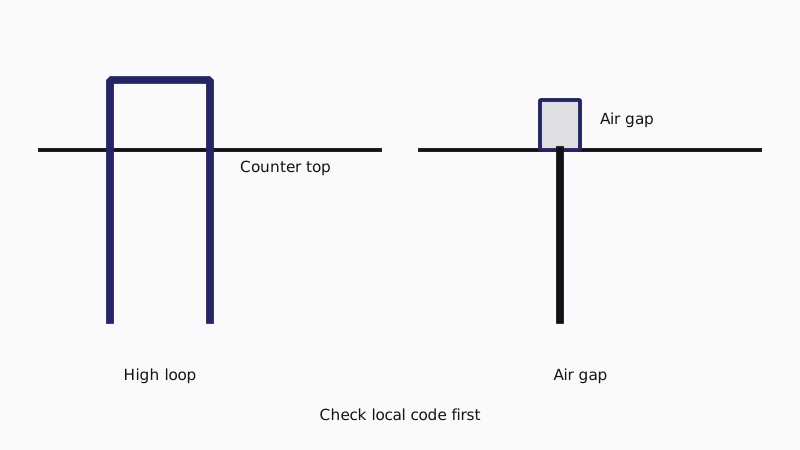
Some places demand an air gap, while others accept a high loop. Check with the building department that serves your address, Building and Safety inside Temecula and the county outside the city, or read the dishwasher manual. A loose hose hanging low and straight down to the disposal is the one arrangement that fails inspection and lets dirty water siphon back.
The slope of the drain run is a third issue. The dishwasher hose should not sag in the cabinet where it could trap water. Clamp the hose to the cabinet wall so the loop stays high.
What does the electrical side look like: plug-in or hardwired?
A disposal needs a switched power supply. Many installations use a power cord plugged into an outlet under the sink that a wall switch controls. Others hardwire the unit to a switched circuit. Adding a new circuit or a new switch is electrical work, so an electrician, or an owner who knows the rules, should do it.
In California, any work that needs a permit goes to a contractor. Replacing one unit with another on an outlet that is already wired correctly is typically not a permit job, while a new outlet, switch or circuit may be, and the building department can tell you. Before you handle any wiring, kill the power at the breaker, then confirm with a tester that it is dead. Water and electricity share this cabinet, so keep the cord up high and clear of the trap.
If the setup has no switch, or the wiring looks damaged, call an electrician before buying a unit. A plumber can install the unit and handle the plumbing side.
Does my home suit a disposal?
On a city sewer, most homes can use a disposal for small bits of food, provided cold water runs generously alongside. Homes on septic, including many in Wine Country, Aguanga, De Luz and parts of Fallbrook and Rainbow, need care, since disposal waste puts more solids in a tank. Check the septic service's advice first.
Grease, bones, stringy scraps such as celery, coffee grounds in volume and starchy foods in quantity can all clog the drain. If your sink already drains slowly, correct that before adding a disposal, and the page on a kitchen sink not draining but not clogged lists the usual reasons. If a jam happens later, the disposal unjamming guide shows the safe steps, and the air switch page covers a different kind of control.
When is a plumber worth hiring for this job?
Get help if the sink has no existing drain layout that fits the unit, the trap needs reworking, the cabinet is cramped, you lack a switched outlet, or the dishwasher hookup is unusual. A plumber also deals with leaks that keep returning after a first-time install.
To ask for a quote, use the quote page. Tell us the sink type, whether you have a dishwasher, the disposal's horsepower or model if you have already bought one, and whether a switched outlet exists under the sink.
Common questions
The dishwasher will not drain since the new disposal went in. Why?
The likeliest cause is the knockout plug still blocking the dishwasher inlet. Next, check the hose for kinks and the clamp, and confirm the hose is looped high or feeds an air gap. If the disposal itself is clogged, clear it, because the dishwasher drains through it.
Must the dishwasher be connected to the garbage disposal?
No. A dishwasher can drain to a tailpiece branch on the sink or to a separate connection, and some homes use an air gap. If a disposal is present, connecting through its inlet is common. Find out what your dishwasher's instructions and your local code allow.
Where does the dishwasher hose attach on the disposal?
It slips onto the small inlet at the side of the unit, usually near the top. Look for a short nipple with a plastic plug inside it. The larger outlet lower down is the discharge to the trap and takes the other pipe.
Can I fit a garbage disposal on my own?
Plenty of homeowners do, provided the sink is a standard one and a switched outlet already exists. Take your time with the flange seal and with the knockout plug. Call a plumber if the trap needs reworking, and an electrician for any wiring change.
How long does a garbage disposal last?
No set figure applies. Motor size, how often it runs and what goes down the drain all matter, and many last for years. A body that leaks, a motor that hums without turning and repeated jams all suggest the unit is close to finished.
For the wider picture, start with plumber across Temecula.
Updated