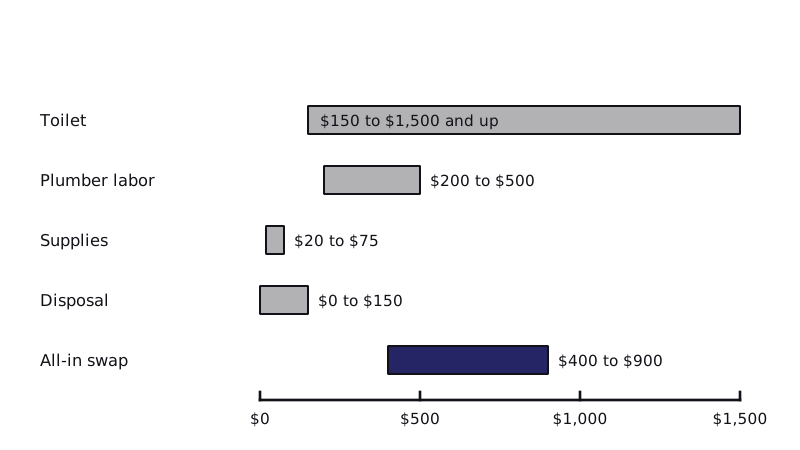
According to a 2026 cost guide from Block Renovation, the total for a standard toilet replacement is around $400 to $900. That figure includes the toilet itself, the plumber's labor, supplies and disposal of the old unit. If a single part is the problem, check toilet repair first, because a flapper is only a small share of this. To get a number for your own bathroom, use the quote page.
What total counts as fair for a toilet replacement?
Plan on $400 to $900 for a plain swap where the old toilet lifts out without trouble. Block Renovation breaks that down as the toilet at $150 to $1,500 or more, labor at $200 to $500, wax ring and supplies at $20 to $75, and disposal at $0 to $150. A quote well outside that band calls for an explanation.
Temecula prices should land near those national ranges, though the guide notes big metros can be 30 to 50 percent higher, and a plumber driving out to a rural lot in Wine Country or Fallbrook may add travel time. A fair quote names the toilet model, states whether disposal and supplies are included and gives labor as a flat figure.
How is the cost split between the toilet and the labor?
Labor is the more predictable half. Block Renovation gives $200 to $500 per job, normally by the job instead of hourly, since a clean swap takes a few hours. The toilet varies far more: basic models begin near $150, mid-range ones fall around $300 to $500, and premium or smart toilets exceed $1,500.
| Line | Guide range |
|---|---|
| Toilet | $150 to $1,500 and up |
| Plumber labor | $200 to $500 |
| Wax ring, bolts, supply line, caulk | $20 to $75 |
| Disposal of old toilet | $0 to $150 |
| Typical all-in swap | $400 to $900 |
Fixr's published guide, by contrast, lists a flat $120 for a basic toilet job and a service call of $50 to $300, which shows how far the low end can reach if you supply the toilet and the job is simple. Buying the toilet yourself can save money, but ask the plumber first whether they will install a toilet they did not supply.
What pushes a toilet swap above the usual range?
Whatever is hiding beneath the old toilet. A cracked or rusted flange costs $150 to $400 to repair, a stuck or leaking wall stop valve $75 to $200, and a soft subfloor more than either. Block Renovation totals the possible add-ons at $200 to $2,000 or more. Ask the plumber to price each item separately so you can approve them as they come up.
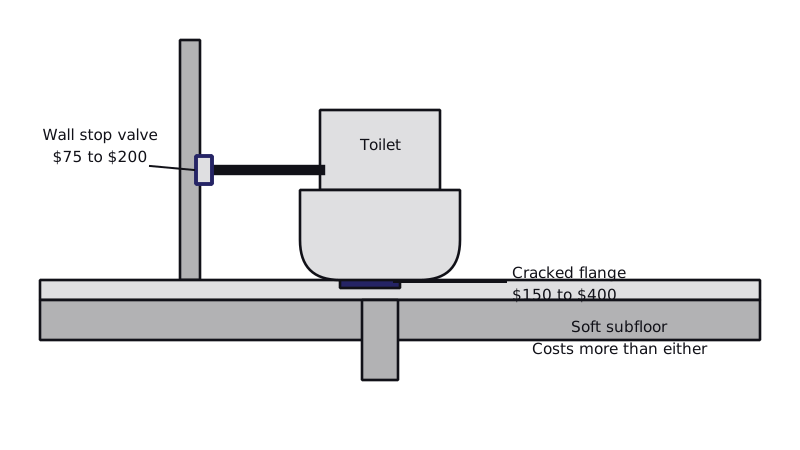
Local conditions play a part. Around Rancho California, 1980s and 1990s homes often have wall valves that have not turned in decades, and a valve that snaps or will not close turns a simple swap into a longer visit. Hard water, which Rancho Water reports at roughly 13 to 14 grains per gallon, tends to freeze stop valves in place with mineral scale. Moving a toilet to a new spot, or going from a rear to a floor drain, is remodel plumbing and is priced separately.
Can you replace a toilet yourself to save the labor cost?
Yes, provided you can lift a heavy fixture and fit a new wax ring. The sequence is to turn off the water, drain the tank, unbolt and raise the bowl, scrape away the old wax, seat the new ring and bowl, tighten the bolts evenly, reconnect the supply and test. Stop on finding a damaged flange or subfloor.
The true danger is a leak that surfaces weeks afterward. A badly seated bowl can seep into the subfloor for a while before it appears on a ceiling below or as a damp patch. Allow an hour or two if things go smoothly, and bring in a plumber when the water supply valve will not close fully. The plumber for clogged toilets page covers jobs that stop short of replacement.
What would a new toilet handle alone cost?
Very little. Hardware stores sell side-mount handles cheaply, and many people install them without help. The mounting nut inside the tank is normally reverse-threaded, so turn it clockwise to loosen it, and pick a handle with the same finish and length. A handle that is merely loose may need only a tighter nut or a fresh chain.
For the signs, see the page on a loose toilet handle that will not flush. Should a plumber already be there for another job, a handle swap usually adds little.
How much does re-plumbing an older home cost?
That job is on another scale. Bob Vila's 2023 guide quotes $1,500 to $15,000 for a whole-house repipe, averaging $7,500 nationally. Local homes from the 1970s and 1980s are at the age where owners begin asking, and fuller coverage sits on the repipe house cost page and the PEX repipe cost page.
Other jobs we arrange appear on the Temecula Pipe and Repair home page. Whether a bathroom's supply lines are the weak link is something only a plumber on site can tell. If a quote for a toilet swap comes with a warning about corroded supply pipes, ask to see them.
Common questions
How much does a plumber charge to swap a toilet?
Block Renovation says most jobs fall between $400 and $900 with the toilet, labor and supplies all counted. Labor by itself typically costs $200 to $500. Supplying the toilet yourself means you mainly pay for the visit. The exact price comes from the plumber once the shutoff valve and the rest of the bathroom have been inspected.
Is $300 for a toilet install fair?
It can be, if that figure covers only labor on a clean swap and you supply the toilet. Labor of $200 to $500 is the typical range. If it is meant to include the toilet, $300 would suit only a budget model. Ask what the figure covers, and whether supplies and disposal are in it.
What is the average labor cost to replace a toilet?
Block Renovation gives $200 to $500, billed per job. Fixr's guide shows a flat $120 at the bottom for a basic job. Expect the plumber to be on site for a few hours. Labor rises with hard-to-reach tanks, tight spaces, upstairs bathrooms and repairs found underneath.
Should I buy the toilet myself?
Often it makes sense. Plumbers may mark up a toilet they provide, so your own purchase can cost less. Measure the rough-in, meaning the distance from the wall to the middle of the floor drain, to be sure it fits. Ask whether the plumber installs customer-supplied toilets and whether any warranty applies.
Can I install a toilet myself?
Yes, carefully. A first-timer should allow a couple of hours, a helper to lift the bowl and a new wax ring. Hand the job to a plumber when the floor feels soft, the wall valve will not close or the flange is damaged. Hidden damage from a leak beneath the bowl often costs more than the visit that would have prevented it.
Updated