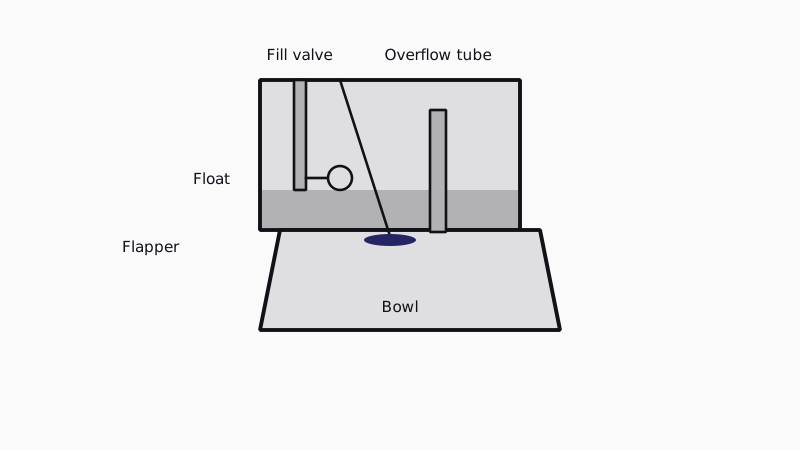
A steady trickle into the bowl usually points to the flapper inside the tank, and a damp floor around the base points to the wax seal. A local plumber can mend either in a single visit, and the flapper is often a ten-minute job you can do yourself. Submit the quote page form and we line up a plumber to visit your Temecula address. The home page describes how that works.
Which toilet part fails first?
The flapper, by a wide margin. This rubber cup lifts when you flush and drops back down to seal the tank. Over the years rubber hardens and warps, so water slips past, the tank refills again and again and the toilet hisses or runs on its own. Fill valves are the second most common culprit, and the wax seal where the bowl meets the floor ranks third.
Match the sign to the part:
- Hiss, or a refill every few minutes: the flapper, a chain that has too much or too little slack, or a fill valve jammed in the open position. Begin with stopping a running toilet.
- Puddle at the base: wax seal, loose closet bolts or a cracked flange.
- Handle that flops or sticks: lever arm or chain. See a handle that is loose and will not flush.
- A flush that begins strongly and then weakens: blocked rim jets or a partly lifting flush valve, covered on the toilet flush repair page.
- Droplets forming outside the tank: often condensation, sometimes a tank bolt washer.
A silent leak can be caught with a simple test. Add several drops of food coloring to the tank and wait ten minutes. If the bowl water changes color, the flapper is leaking, according to the EPA's WaterSense program, which also advises replacing flappers at least every five years.
Where does DIY end and a plumber begin?
Everything inside the tank is fair game: flapper, chain, lever, fill valve. Turn off the wall stop valve, flush, sponge out what remains and photograph the old part before buying its twin. Lifting the bowl, a stop valve that refuses to turn, or a drain line all belong to a plumber, since a bad seal quietly ruins a subfloor.
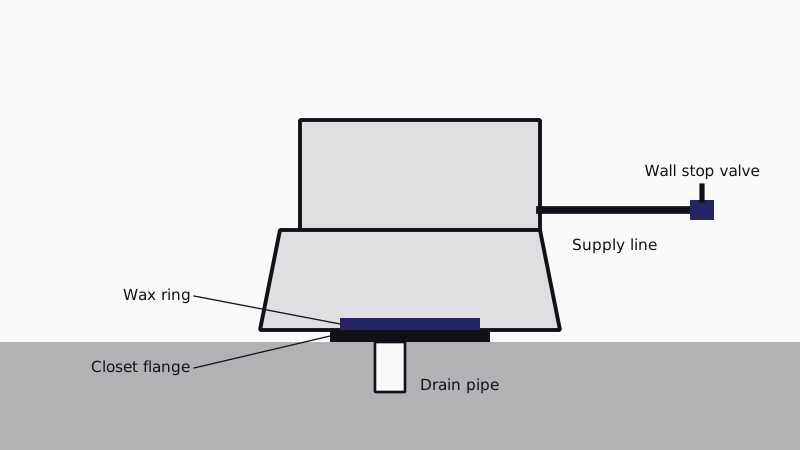
Some habits that keep a simple repair simple:
- Turn the stop valve gently. A stiff or weeping one should not be forced, so book a visit instead.
- Take the old flapper with you to the shop. Sizes and ears differ, and the flapper valve types guide shows the common ones. The flapper repair walkthrough covers the swap itself.
- Hand-tighten porcelain bolts, then add one quarter turn.
- Fit a fresh wax ring any time the bowl comes up.
When is a cracked or tired toilet better replaced than mended?
Replace when the porcelain itself has failed. Leaks through the bowl or tank cannot be sealed, hairline cracks creep, and a toilet that needs three parts at once is often cheaper to swap. If the fault is a bolt-on part, repair it. Older tract homes in Rancho California often have original fixtures, so request both prices from the plumber. The figures are on the replacement cost page.
A blocked toilet is a separate problem from a broken one. For that, see help with a clogged toilet.
Handyman or plumber for a toilet job?
A handyman can handle a seat, a handle or a flapper. Anything touching the shutoff valve, the supply line, the drain or the floor seal counts as plumbing. In California a contractor license is generally needed once a job hits $1,000 in labor and materials or requires a permit, so small swaps often stay below that line. For anything larger, look up the rule at the Contractors State License Board site ahead of hiring.
Ask for the plan if a valve sticks, which matters more than the job title. What happens if the wall valve refuses to close: who shuts the main, and does the visitor carry a spare valve? Replacing the wall valve is a plumber-level job, with Block Renovation listing it at $75 to $200.
Can the same visit cover other bathroom problems?
Yes, and it pays to list everything first. In one trip a plumber can examine a dripping faucet, a tub spout, a shower valve and the supply lines under the vanity. Tile, cabinets and paint are other trades, but a plumber does rough in pipes for remodels, as our bathroom remodel plumbing guide explains.
Homes built in the 1990s and 2000s in Redhawk and Harveston often have fixtures from the same builder package, so when one tires the next usually follows. Walk the bathroom with a notepad and note anything slow, loud or damp.
What does a toilet repair cost?
A flapper or fill valve swap is usually one flat fee, not far off the price of a service call. Fixr puts service calls at $50 to $300 and toilet installation labor near $120. Block Renovation lists full replacement labor at $200 to $500 and flange repair at $150 to $400. Treat all of it as a guide, because the plumber quotes after looking.
| Job | Guide range |
|---|---|
| Flapper or fill valve | Often one flat fee near a service call |
| Flange repair | $150 to $400 |
| Wall stop valve | $75 to $200 |
| Replacement labor | $200 to $500 |
Hourly rates are covered in what plumbers charge per hour.
Common questions
How do I narrow down a toilet fault before calling anyone?
Lift the tank lid and flush while watching. A flapper that falls slowly or sits crooked, a chain tangled under it, or a float that rides too high shows the problem within a minute. If the parts look fine and the floor is wet, the leak is below the bowl, and that needs a plumber.
Is there a standard call-out charge?
No fixed figure exists. Plenty of plumbers charge a call-out fee, and the Fixr guide lists $50 to $300 depending on the plumber's grade. Some credit the fee toward the repair; others add it on top. Ask which applies, and get the price written down ahead of the work.
Roughly what would a complete toilet swap come to?
Block Renovation's 2026 guide gives $400 to $900 for a standard replacement including the toilet, labor, supplies and disposal. The toilet alone starts near $150 for a basic model. A rotted flange, a stuck stop valve or damaged flooring pushes the total higher, so ask for those to be itemized.
What if money is tight this month?
Close the wall valve to stop the waste and use another bathroom if there is one. According to the EPA, leaks cost the average household more than 9,300 gallons yearly. A flapper kit is cheap and often worth trying first, and the food coloring test shows whether it is the culprit.
How much is a running toilet repair?
Usually about the price of a single visit, so $120 to $300 is a sensible expectation, going by Fixr's toilet labor and service call figures. Wax seal and flange work cost more, with flange repair listed at $150 to $400. The final number comes from the plumber who looks at it.
Guides in this section
- Running after a flush
A toilet that runs after you flush usually has a stuck chain, worn flapper, high float or tired fill valve.
- Fixing running toilet bowl
A toilet that keeps running wastes water and shows up on your bill.
- Glacier bay dual flush
Dual flush toilet that will not stop running?
- Toilets
A slow toilet can mean a sluggish flush or a slow refill.
- Toilets
How to tighten a loose toilet seat, plus quick fixes for a flush button, handle, flapper, slow flush and flush valve, and when a Temecula…
- Leaking toilet bowl
Water pooling around a toilet could be the wax ring, tank bolts, supply line or a cracked bowl.
- Leaky toilet tank repair
Tank leaking onto the floor or sweating in summer?
- Plumber for toilet leak
Water around the base, a dripping supply line or a sweating tank?
- Repair a toilet fill
How to repair or replace a toilet fill valve, when the flapper is the real culprit, what a burst supply line means, and what a running…
- Repair toilet overflow tube
A toilet overflow tube that is cracked, too short or flooded constantly runs water into the bowl.
- Replacing toilet flush valve
Can a toilet flush valve be replaced without lifting the tank?
- Toilet flapper chain replacement
How long the flapper chain should be, how to swap or reset it in ten minutes, and why a chain that is wrong keeps a toilet running.
- Toilet flapper repair
Pick the right flapper size, set the chain slack, clean the seat and test for leaks.
- Toilet flapper valve types
Two inch, three inch, ear mount, ring mount, tank ball and canister: how to identify the flapper type your Temecula toilet uses before you…
- Toilet handle loose
A loose toilet handle that won't flush has a loose mounting nut, a detached chain or a broken lever arm.
- Toilet runs every few minutes
A toilet that refills by itself every few minutes has a slow leak from tank to bowl.
- Toilet running when not in use
A toilet that runs or refills by itself is leaking water.
- Toilet sounds like running
Hissing, trickling, gurgling or a whistle from the toilet each point at a different part.
- Toilet water keeps running
Toilet water that never stops is coming from the fill valve or spilling down the overflow tube.
- Running toilet diagnosis
A toilet that won't stop running is usually a worn flapper, a bad fill valve or a chain problem.
- Toilet replacement cost
What it costs a plumber to replace a toilet in Temecula: the toilet, labor, supplies, flange and valve extras, and how to judge whether a…
- Toilet flush repair
Handle slack, weak flush or a toilet that keeps running after the flush: what each symptom means and which fixes you can do before a…
- Toilet keeps running
A toilet that will not stop running is nearly always the flapper, fill valve or water level.
- Toilets
A running toilet wastes water and pushes up your Temecula bill.
Updated