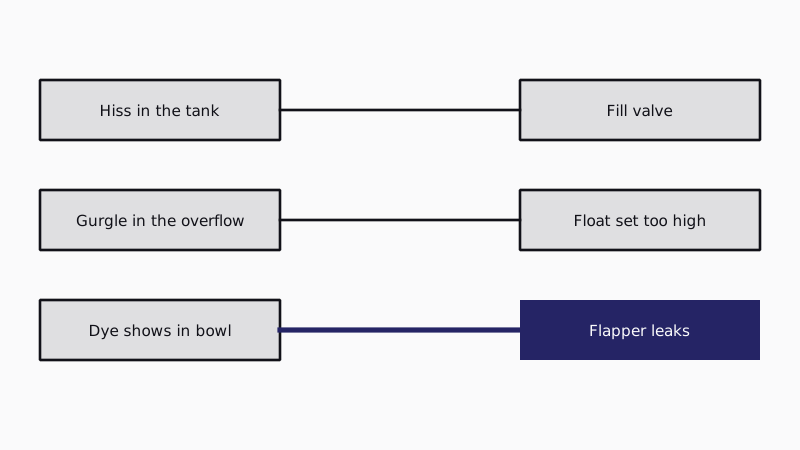
A toilet that seems to be filling although nobody has used it is letting water escape from the tank, usually around a worn flapper, while the fill valve makes up the loss. That cycle can go on all day. The EPA describes an old flapper as a source of silent leaks costing thousands of gallons a year. For the whole range of toilet jobs, begin at the toilet repair page.
Why does a toilet run on its own when no one is using it?
Most often the flapper has stopped sealing, so tank water seeps into the bowl and the fill valve kicks on again every few minutes. Next in line is a fill valve unable to shut off, and third is a chain that is tangled or too short. Take off the lid and all three can be checked within minutes.
Rubber ages. Where the water is hard, a mineral film builds on the flapper seat and on the rubber, and a tiny gap is enough to leak. Chlorine tablets in the tank can also wear flappers out faster. A soft, warped or slimy flapper should be replaced.
The guide to a toilet that keeps running covers each cause in more depth, while this one is organized by what you hear and see.
What does each symptom mean?
Every sound or sign narrows the field to a few parts. A refill every few minutes points to the flapper, a steady hiss points to the fill valve, and a trickle down the center pipe means the water is set too high. Listen, look and test first, then swap one part at a time so you know which fix worked.
| What you notice | Likely cause | First step |
|---|---|---|
| Tank refills for a few seconds every few minutes | Leaking flapper | Dye test, clean seat, replace flapper |
| Constant hiss, water never stops | Fill valve not closing, or float set high | Lower float, clean or replace valve |
| Trickle into the overflow tube | Level above tube | Lower float until water sits about an inch under the top |
| Runs only after a flush | Chain too tight or too slack | Leave the chain a bit loose |
| Whooshing sound without refill | Valve or supply noise | Check the shutoff and supply |
| Dripping at the base | Wax ring or bolts, not the tank | Call a plumber |
Not every symptom comes from the tank. A leak at the floor or a rocking bowl signals a seal problem, and it deserves quick attention to protect the subfloor.
How do I check for a hidden leak?
Add a few drops of food coloring to the tank and let it sit about ten minutes without flushing. According to the EPA, a bowl that picks up the same color means the flapper is leaking. Flush afterward so the tank does not stain. Another option is to mark the water level, close the supply valve and see whether the level drops over an hour.
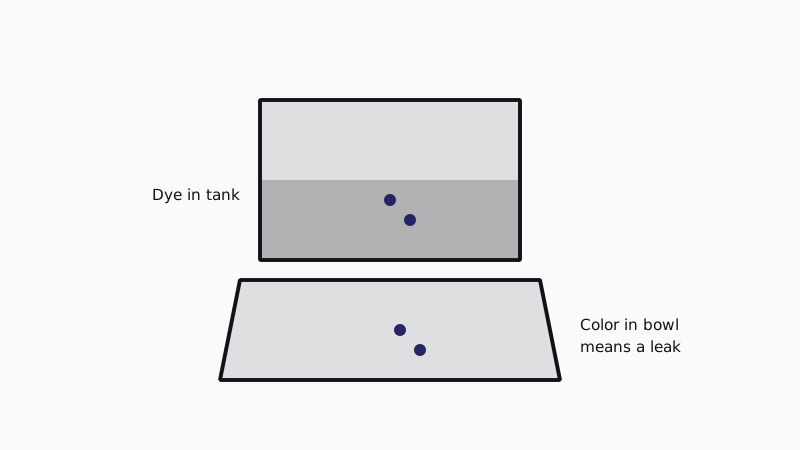
You can also listen at night in a quiet house. A faint hiss, or a pulse of water every few minutes, signals ghost refills. A meter test helps too: turn everything off, then watch the dial. If it moves at all, water is getting out somewhere, and the toilet is a prime suspect.
When the test is positive, a new flapper is a cheap fix that many people handle themselves. The guide to flapper repair shows how, and the guide to fill valve repair covers the valve in the same way.
Is this a do-it-yourself repair, and how is it done?
Mostly, yes. Close the supply valve, flush the tank empty, and take a look inside. Clear the film from the flapper seat with a cloth, adjust the chain so it hangs slightly loose, and put in a new flapper if the old one is worn, matching the size and style to your toilet. Reopen the valve gradually and watch the water level.
Buy the part designed for your model. Flappers come in several sizes, and dual-flush toilets use different seals. Carry the old part to the store, or jot down the brand named on the tank. A cheap mismatched flapper may seal badly and let the trouble return.
If the toilet still runs, swap the fill valve, an easy job. Stop and get help if bolts are seized, the tank is cracked, or water is showing at the base of the toilet.
At what point should you hire a plumber?
Phone one if repairs do not last, if the toilet is old and several parts are worn, if the shutoff will not close, if water shows up around the base, or if you would rather not take the tank apart. A plumber can replace parts, test the result, and say whether the toilet deserves to be kept.
We forward your request to a local plumbing business, and that business makes the visit, not us; the businesses that accept requests pay us a fee. They set the price, so none is printed here. To weigh a full replacement, see the toilet replacement cost page for what goes into it.
Use the quote page to give the toilet's age, what you hear and what you have tried. The home page shows more jobs.
Common questions
How much water is lost to a running toilet?
It varies with the leak, but it can be a lot. For households, the EPA estimates leak losses above 9,300 gallons a year, and a leaking flapper is one common cause. When the bill has gone up and the toilet runs, deal with it before searching elsewhere.
Why does my toilet turn itself on every few minutes?
A slow flapper leak is the sign. The tank level sinks slightly, then the fill valve opens to replenish it and shuts again, and the cycle starts over. A dye test confirms the cause, and a new flapper usually ends it. Keep the old one for matching if you need to shop for another.
How do I tell a flapper fault from a fill valve fault?
When the tank level drops as water slips into the bowl, the flapper is at fault. If the tank stays full yet water keeps entering, blame the fill valve, or a level set too high. Watching where the water goes tells you which part to blame.
Does hard water make a toilet run?
Yes. Mineral scale can build on the flapper seat and valve parts and stop them sealing. Rancho Water's reports put average hardness around 230 to 240 mg/L in the 2020 to 2023 editions. Cleaning the seat and replacing rubber parts every few years is usually enough to prevent it.
Updated