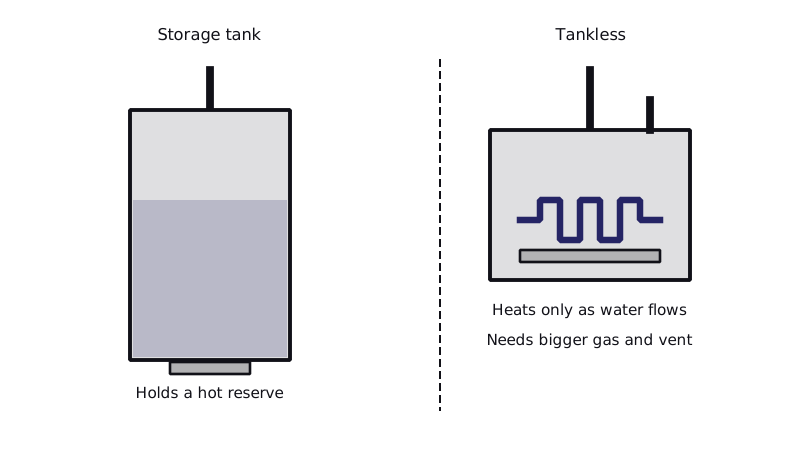
Choose a storage tank when the goal is the cheapest job and the same footprint as before. Choose tankless when hot water use is modest, wall space is tight and you can live with a bigger install and a yearly flush. Three things swing the decision in Temecula: gas pipe size, vent route and hard water. Begin at the water heater service page, then get a written quote.
Which one fits a typical Temecula home?
For most single-family homes in Temecula, a gas or electric storage tank is the simpler fit, and a tankless unit is worth a look when you are already redoing the closet, the vent or the gas line. A tank swaps into the same spot. A tankless unit moves the heat to the wall and changes what the plumbing has to carry.
Think about three things before you compare brands.
- How many things run at once. A tank holds a reserve, so a shower plus a dishwasher plus laundry only strain it when the reserve is gone. A tankless unit keeps no reserve, so its flow rating caps how many taps it can feed.
- What the house already has. Redhawk, Harveston and older Rancho California tracts commonly tuck the heater into a garage closet with a short vent. That layout favors a tank. Roripaugh Ranch and other 2010s homes are newer, but closet size still limits what fits.
- Where you plan to live. A tankless unit lasts longer, so it pays back more slowly for a house you will sell in a few years.
How much does a tankless heater really save on energy?
According to the US Department of Energy, the gain is roughly 24 to 34 percent for homes using 41 gallons of hot water a day or less, and roughly 8 to 14 percent for homes near 86 gallons. A household that draws more sees a smaller edge.
That is the honest answer to the "calculator" and "benefits" searches. A tankless unit has no standby loss because it is not keeping 40 or 50 gallons hot all day. If the house sits empty at work hours, that matters. If the tap runs from 6 am to 11 pm, it matters less.
Fuel type changes the math too.
| Setup | What to expect |
|---|---|
| Gas tank | Lowest purchase price, vent already in place, standby loss all day |
| Gas tankless | Larger gas supply plus a sealed vent; biggest savings with light use |
| Electric tank | Easy install, higher running cost per unit of heat |
| Electric tankless | Large electrical demand, often a service panel question, small footprint |
| Propane tank or tankless | Same hardware as gas, but you buy fuel by the gallon, so fuel price swings count |
Gas is piped by SoCalGas in much of the city. Outer parcels and rural lots, such as parts of Wine Country and Aguanga, often run on propane or electric, so check what feeds your house before you price tankless.
What does installation involve for each type?
A tank swap puts the new heater where the old one stood and reconnects water, fuel or power, vent and relief valve. A tankless install usually adds a vent upgrade, frequently a bigger gas pipe or a dedicated electrical circuit, a condensate drain on condensing gas models, and service valves for flushing.
Both generally count as permit jobs. Temecula Building and Safety issues them for addresses within the city. Parcels beyond the city limits, such as French Valley, Winchester and Aguanga, answer to Riverside County, while Fallbrook and Rainbow addresses answer to San Diego County. Settle who files the permit before work begins.
Gas piping is not a weekend project, since any permitted job in California calls for a contractor license. Should you smell gas, go outdoors before anything else, then dial SoCalGas at 1-800-427-2200, and 911 as well if someone is at risk. For pipe sizing see the gas line page, and for the price side the piece on tankless install cost.
Does Temecula's hard water hurt a tankless unit?
It can. Minerals in hard water bake onto hot metal, and a tankless heat exchanger has narrow passages that scale narrows further, which cuts flow and efficiency. Rancho California Water District's reports from 2020 to 2023 show average hardness around 230 to 240 mg/L, about 13 to 14 grains per gallon.
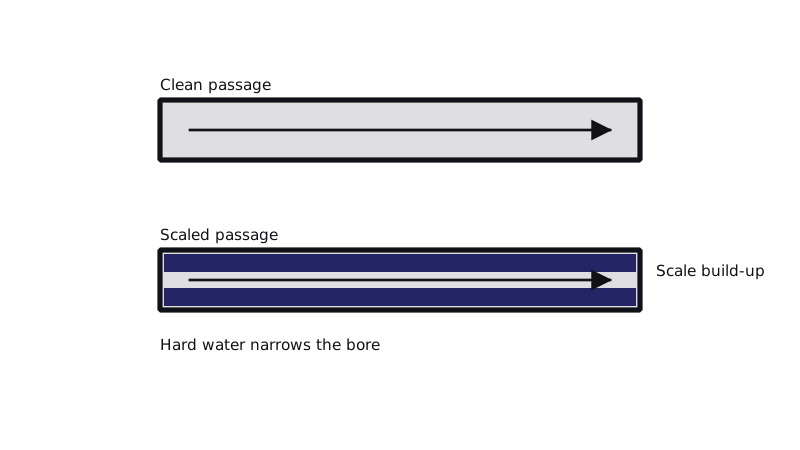
That counts as very hard water. Plan on one of these:
- Flushing the unit each year through service valves added at install, on the maker's schedule.
- Water treatment upstream of the heater; the softener installation page explains it.
- Reading your bill to learn whether Rancho Water or Eastern Municipal Water District serves your street, then checking that district's newest report.
Tanks suffer as well. Scale drops to the bottom as sediment, the burner rumbles and the steel ages faster. Draining the tank once a year and inspecting the anode rod will limit the wear, and the scale prevention page goes through the options.
Which type outlasts the other, and what fails first?
Tankless wins on lifespan. The Department of Energy expects most tankless units to run for over 20 years, and their parts can be swapped. Tank life swings with water quality, anode condition and use, so any year count is only a guide.
Failure modes differ. A tank typically leaks, loses a thermostat or burns out an element. A tankless unit throws error codes, trips on a flow sensor or igniter, or clogs with scale. Brand-specific faults on electric models are on the electric tankless repair guide, and tank timing is on the page about replacement timing for water heaters.
What about a mini tank or a propane model?
Mini tanks are compact electric storage heaters, often 2.5 to 20 gallons, serving one sink or a faraway bathroom. It will not heat a whole house. Think of it as a cure for a long wait at a single tap, plugged into a nearby circuit.
Propane works with either whole-house type. A propane tank can run as cheaply as other fuels when the unit is efficient, but you are tied to deliveries, the tank placement rules and a fuel price you do not control. In rural pockets around Wine Country and De Luz, propane is common, so ask the plumber about tank clearance and the vent.
What changed since 2016?
Comparisons dated 2016 still circulate and describe older equipment. Efficiency labels, vent products and controls have moved on, and so have gas and power rates. Lean on the Department of Energy page for percentages, and make any quote name the model, its efficiency rating and the whole scope, vent and gas pipe included.
Regulations count as well. The regional air board declined in June 2025 to amend its water heater emission rules, so nothing forces a tankless purchase right now. California's energy code can still affect new equipment, so the plumber should explain how the permit covers it.
Common questions
Does tankless make sense in a rental property?
Only when the old heater is already failing and the owner wants longer life in less space. Tenants rarely notice the difference, and a tank is the cheaper job. Tankless savings build over years of light use, which a short ownership period may not repay.
Will a tankless unit fit where the old heater stands?
Sometimes. The spot must allow the maker's vent clearances, a gas pipe sized for the burner and room to service the unit. Many garage closets need a new vent route and a wider pipe. Ask for those measurements before the price, not after.
Does tankless always mean a bigger gas pipe?
Often. Next to a tank burner, a tankless one draws much more gas in a single moment, so the supply pipe between the meter and the unit has to handle that load. Some homes already have enough capacity and need only a short extension. Unit rating and run length let the plumber size it, and a permit is needed for the job.
Which suits a busy family better?
Neither wins outright. A household running hot water all day sees thinner tankless savings, while a tank supplies a steady reserve. A bigger tank or two linked units can bridge the gap. Say how many showers overlap and ask each quote for a flow rate.
How do I get a quote on either type?
Send it through the quote page. Local plumbing businesses pay us a fee to receive these requests. We hand yours to one, which then prepares the quote and does the job. Mention your fuel, where the heater sits and how old the current one is.
Every service and price guide is on plumber temecula.
Updated