
Most houses are repiped once, if at all, and what triggers it is evidence, not a birthday. Pipe life hinges on what it is made of, how the water flowing through it behaves and how well it was installed, ranging from a few decades to well beyond. If you are weighing it up, the main page on repiping and pipe replacement covers the job itself, and this page covers the timing question.
Does a house need repiping after a set number of years?
There is no set number, though the material suggests a rough window. Galvanized steel generally gives out after several decades by most accounts, while copper often outlasts it, and plastic systems like PEX are newer with a shorter track record. Workmanship and water chemistry move all of these, so condition matters more than age.
Treat age as a reason to look, not a verdict. Here is a rough guide by material, with every figure a general expectation and not a promise:
| Pipe in the house | What to expect |
|---|---|
| Galvanized steel | Rusts internally; often trouble by mid-life |
| Polybutylene (gray plastic, mostly 1970s to mid-1990s) | Known for failing at fittings; many owners replace it early |
| Copper | Long-lived, but pinholes and joint failures can appear |
| CPVC | Can turn brittle with heat and age |
| PEX | Newer; the record is shorter, but it resists scale and freeze splits |
Ask the plumber to identify your pipe and describe how it has fared in this valley. When deciding on the replacement, read PEX versus copper.
Which signs say a house is ready for a repipe?
Repeat leaks are the clearest sign. One pinhole is a repair, while three in two years is a pattern. Other signals are discolored water, falling pressure that cannot be traced to a regulator, green or white crust at joints, pipes that sweat or stain walls, and water that tastes of metal.
Run through a short checklist:
- More than one leak in a few years, in different spots.
- Brown or orange water the first time you open a tap in the morning.
- Pressure that is low at every fixture, not just one.
- Visible corrosion at fittings, valves or under sinks.
- Pipe material you know has a bad record.
- A recent inspection that flagged plumbing.
Pressure matters here. Low pressure can also be a worn regulator, which costs far less to replace, so rule it out first with the pressure guide. Expert judgment beats guessing, since the plumber can examine the material, cut out a sample and estimate the life that remains.
What age are the pipes in Temecula homes?
Most Temecula tract homes date from the 1980s to the 2000s, with newer neighborhoods from the 2010s. Rancho California began in 1964 and its early tracts are older. Redhawk and Harveston are master-planned areas of the late 1990s and 2000s, and Roripaugh Ranch is newer, with newer plumbing. Old Town buildings can have mixed pipe from several decades.
That spread matters. Homes at the older end may carry early copper or other materials of their time, so the pipe in a 1980s house is worth identifying. Homes from the 2010s onward are far less likely to need a repipe for age. The housing details here are general area-level facts, and the only way to learn about your own house is to examine the pipe, the permit history or a plumbing inspection.
In unincorporated parts of the valley, wells and older rural lines add their own variables, because well water chemistry differs from the municipal supply.
Does Temecula's water shorten pipe life?
It can influence it. Rancho California Water District's own reports put average hardness around 230 to 240 mg/L, roughly 13 to 14 grains per gallon, in the 2020 to 2023 reports. That is very hard water, and scale narrows pipes, clogs aerators and works on water heaters. It is not proven to be the reason any single house failed.
Rancho Water's supply is a blend of local groundwater, which it says covers nearly half of its needs, and treated water purchased from the Metropolitan Water District of Southern California. Because the blend changes, the water chemistry reaching your house varies. Some addresses are with Eastern Municipal Water District instead, so check your bill and read the Consumer Confidence Report for your supplier. A softener can slow scale, though it does not make a failing pipe sound.
Is repiping worth the cost?
When the pipe is failing, yes, because the alternative is serial repairs plus the damage each leak causes. The benefits are steady pressure, clean water, fewer leaks and often a quieter house. Still, a repipe is a big project and no job for a hunch. Costs are covered in repipe house cost.
Weigh these against each other:
- The cost of one more repair against the cost of replacing the whole system.
- The damage risk of hidden leaks in walls and ceilings.
- Whether you plan to stay: a repipe is a selling point for an old house, and a buyer's inspector may raise the issue anyway.
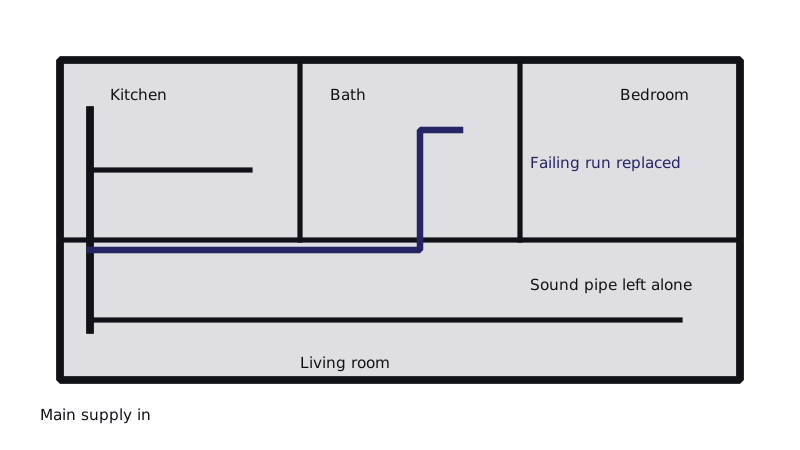
- Whether a partial repipe, such as a failing section, is enough.
A partial repipe is often a real option. Replacing the worst run, such as an attic or slab line, may defer a full job. For a leak beneath the slab, choosing between a slab leak fix and a repipe shows how people usually decide.
What work does a repipe include, and does it cover gas piping?
A repipe swaps out the water supply lines that feed the fixtures, usually for PEX or copper, with walls opened at chosen points and patched later. Gas piping is its own system and falls outside a water repipe. A California contractor license is needed for gas work, and replacing pipe beyond a simple repair generally needs a permit.
Building and Safety issues permits inside the city of Temecula; unincorporated areas use Riverside County. San Diego County Planning and Development Services handles Fallbrook, Rainbow and De Luz. The plumber normally files the application, and an inspection follows. If you smell gas, the rule is the usual one: get out, then phone SoCalGas on 1-800-427-2200 from outside. For the sequence of the job, see repiping step by step, and for the reasoning see why homes get repiped.
Common questions
Can only part of the house be repiped?
Yes. A partial repipe renews one failing run, for example attic supply lines or a slab line rerouted overhead, while sound pipe stays where it is. It suits houses with a localized problem. When leaks keep turning up in different places, the plumber may recommend the whole system, because patching leaves old pipe next to new.
How many years does a finished repipe last?
Material and installation decide. Copper and PEX are both expected to last for decades when installed correctly, but figures differ by manufacturer and water chemistry, so ask for the manufacturer's stated lifespan and the warranty terms in writing. Treat any quoted number as a guide and not as a promise from us.
Is a permit required for repiping in Temecula?
Generally yes, as soon as the work exceeds a minor repair. Within the city limits, the Building and Safety counter handles it, and its listed phone line is 951-694-6439. Outside the limits, the county takes over. The plumber doing the job normally takes care of the permit, and you can ask to see it.
Will my home insurance pay for a repipe?
Usually not for the repipe itself. Policies often exclude wear and corrosion, though sudden water damage may be covered. Terms differ, so read yours and ask the insurer before work starts. Keep photographs and inspection reports of any leak, because they can matter if you do file a claim.
Where do I ask for a repipe quote?
Open the quote page and describe the house: its size, age, the pipe material if known, and any leaks. The request goes to a local plumbing business that pays us for the referral, and that business inspects the house and quotes. Compare two written quotes, line by line.
The rest of our guides start from Temecula Pipe and Repair plumber.
Updated