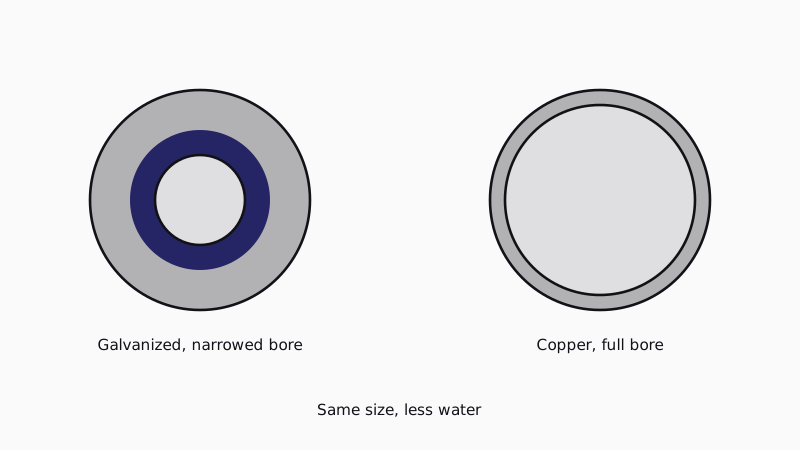
Galvanized water pipe is zinc-coated steel, and as soon as the coating wears away the metal starts to rust from within. Replace it once pressure is poor, the water runs brown or leaks start, and treat it as a planned whole-house repipe instead of patching one stretch after another. You will find it in very old houses and seldom in newer tracts, so first check what you actually have.
How do I find out if my plumbing is galvanized?
Look over any supply pipe you can see in the garage, in a crawl space, beneath sinks or beside the water heater. Galvanized pipe looks dull gray, has threaded joints and attracts a magnet. Copper is orange-brown, CPVC is cream or tan, and PEX is a bendy plastic that comes in red, blue or white. A light scratch revealing gray metal, with rust at the joints, is a warning.
Magnets are a handy test: they grip steel but ignore copper and plastic. Rust weeping from threaded joints, and orange-brown water when you open a tap after the house sat empty, are common signs. The build year is a clue: galvanized went into houses through the mid-20th century. Master-planned tracts in Rancho California started in the 1960s, so galvanized turns up more in older Old Town buildings, rural farmhouses and unincorporated parcels than in tract homes. Assume nothing either way and look at the pipe.
At what point should galvanized pipe be replaced?
Time to replace it comes when pressure is weak at several fixtures, the water looks rusty or discolored, pinholes and leaks keep coming back, or an inspection finds heavy scale inside. Galvanized pipe does not fail to a timetable, but corrosion narrows the bore over the years, and once leaks begin they tend to follow a pattern.
Narrowing explains how a house with galvanized lines can show strong pressure at the meter and only a dribble at the shower. A plumber can test pressure under flow, cut out a sample of pipe to view the interior, and scope the sections within reach. If one section has failed, the others are usually close behind. Spot repairs are hard on threaded pipe, since aged threads tend to snap when disturbed. Very hard water, as across much of Temecula, lays scale on top of the rust. The low water pressure causes page explains how to tell a regulator issue from a pipe problem.
How many days does repiping a house take?
A whole-house repipe often takes a few days, and a small home may finish sooner, but the schedule depends on house size, fixture count, how easily walls can be reached and the pipe material. Water service is cut during part of each day. Expect patching and painting of the access holes afterward, often handled by a separate trade.
PEX runs quickly through walls and attics, whereas copper takes longer because joints are soldered and the pipe is fitted around framing. Request the schedule in writing, including how many hours the water goes off each day and who closes the walls. A plumber should also say whether fixtures like the water heater, toilets and hose bibs are reconnected within the quote. A slab changes the work; see slab leak repair or repipe.
Is a permit required for a house repipe?
Generally, yes. Replacing a home's water supply piping counts as permitted plumbing work in California, and an inspection usually follows. Inside Temecula the City of Temecula Building and Safety office, 951-694-6439, issues the permit; properties outside the city go to the county, Riverside or San Diego.
California requires a contractor license for any job that needs a permit and for any job of $1,000 or more in labor and materials, so a repipe is no handyman task. Typically the plumber pulls the permit and books the inspection. Be cautious if someone offers to skip it, because an unpermitted repipe can create trouble with insurance and with a later sale. Confirm that the quote states who obtains the permit and what the inspection covers.
What is the polybutylene pipe replacement program?
Polybutylene was used to plumb many homes built from the late 1970s into the mid-1990s; a gray plastic pipe with a record of failing at its fittings. A class-action settlement once funded replacement in some homes, but we found no active program to count on, so verify before assuming any money is available.
For a home from that period, a plumber can say whether gray plastic pipe is present, as it is normally stamped with PB and a size. We do not claim that any named tract has it. Houses of that age in Rancho California and nearby areas are simply worth checking, and the water heater connections and sink cabinets are where it tends to show. Replacement is typically PEX or copper, covered in copper pipe versus PEX.
What are my options for new pipe?
Two materials dominate: PEX and copper. PEX flexes, threads through walls needing fewer cuts and does not corrode in hard water, although it should not be used outdoors in sunlight. Copper is durable and familiar, but costs more, takes longer to install and can develop pinhole leaks in some water. Most plumbers will recommend one after seeing the house.

Ask which fittings will be used, as crimp ring, clamp and expansion systems each follow their own rules. Ask also whether new lines are insulated where they cross attics or exterior walls. The repipe house cost page covers cost, including the factors that drive a quote.
How do I request repipe quotes?
Use the quote page to state the house's age, the pipe you found, the bathroom count and anything you have noticed. We pass the request to a local plumbing business, and the businesses that accept requests pay us a fee. That business then contacts you to arrange a visit. Phones are answered weekdays from 9am to 5pm. The Temecula Pipe and Repair home page shows the wider list of work.
Common questions
Can galvanized pipe harm your health?
Mostly it is a flow and leak problem, and not an immediate hazard. Rust and scale can discolor water and clog fixtures. Old pipe may also hold other metals in its coating or scale, so if drinking water worries you, contact the water district about testing and read the district's Consumer Confidence Report.
Can galvanized pipe be patched rather than replaced?
A short section can be replaced using transition fittings, yet aged threads often break under disturbance and the remaining line is usually in similar shape. A repair makes sense when only an exposed length has failed. When pressure is low throughout the house, a full repipe is normally the lasting answer.
What is the lifespan of galvanized pipe?
No fixed figure exists, because it depends on water chemistry, how heavily the pipe is used and the quality of the zinc. Many plumbers say several decades is normal, with trouble starting as the coating wears thin. Hard water with heavy scale, and high pressure, can shorten that span.
Must I move out while the house is repiped?
Many people stay put. Still, the water goes off for part of each day and the work brings noise and dust, so some prefer to sleep elsewhere. Ask the plumber for the hours the supply will be off and what arrangements cover toilets and kitchens meanwhile.
Is it okay to join copper to galvanized pipe?
Not directly. Copper joined straight to galvanized steel sets off galvanic corrosion at the joint, so a plumber fits a dielectric union or a transition fitting. Many plumbers would rather replace the whole run, which removes that weak point and keeps flow even.
Updated