PEX is usually faster and cheaper to install, tolerates hard water scale without pitting and bends around corners. Copper is rigid, long-proven and tolerant of heat, and it works outdoors and wherever UV or pests are a worry. Neither is the wrong answer: the best one depends on your house, access and budget. The repipe overview shows how a whole-house job runs.
How do copper and PEX mainly differ?
Copper is a rigid metal tube joined by solder or press fittings, whereas PEX is flexible cross-linked polyethylene joined by crimp, cinch or expansion fittings. PEX comes in long lengths with fewer joints, which speeds up a repipe. Copper costs more as material and takes longer to put in, yet homes have relied on it for generations.
| Point | Copper | PEX |
|---|---|---|
| Installation | Slower, soldered or press joints | Faster, fewer joints, flexible runs |
| Material cost | Higher | Lower |
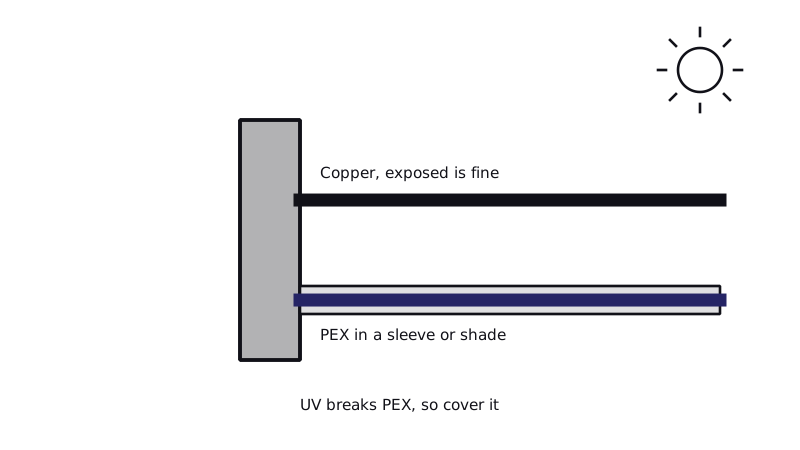
| Sunlight and outdoors | Fine | Must be shielded from UV |
| Hard water | Can pit or pinhole in some water | Does not corrode or pit, though scale can still deposit |
| Freeze tolerance | Can split | Often expands, but can still fail |
| Noise | Can ring or bang | Quieter |
| Heat and fire | Not combustible | Plastic, needs care near flues and heaters |
Which is the better choice for drinking water?
The plumbing code allows either material, and both are widely used for drinking water. Copper has decades of history behind it and gives off no odor, whereas PEX is plastic and a few people pick up a taste while it is new. Check that any PEX you purchase is stamped as approved for drinking water, and flush new lines before drinking from them.
The water supply matters as well. Rancho California Water District's reports give average hardness of about 230 to 240 mg/L, which is very hard, and water that hard may deposit scale inside copper lines and fittings. Some water chemistries can also pit copper over decades. PEX does not corrode, but long exposure to high chlorine can still damage it, so ask about the manufacturer's ratings. If you notice an odd taste or have a concern, ask your water district for the Consumer Confidence Report.
What is PEX's service life next to copper?
Manufacturers often cite several decades for PEX, and copper commonly outlasts it in good conditions, but real results depend on water, pressure, heat and installation. Neither lasts forever, so treat any figure as a ballpark. Copper can fail through pinholes in some water, and PEX can fail through sunlight, chemical contact or a bad fitting.
PEX arrived in homes more recently, so there are fewer years of evidence. Copper installed between the 1960s and 1990s still serves many houses, though pinhole leaks do show up. After one, turn to the guide on mending a pinhole leak in a copper line. A warranty on the pipe and fittings, if offered, is worth comparing across quotes, but read the terms yourself.
How do PEX-A and PEX-B differ, and which suits burial?
PEX-A is the most flexible, recovers from kinks with heat, and is joined with expansion fittings. PEX-B is a little stiffer, costs less and is joined with crimp or cinch rings. PEX-C is less common. Either type can be buried if the product is rated for it, but fittings should stay accessible and protected, so a plumber makes the call.
Underground, confirm that the PEX carries the right rating, keep joints out of the ground where possible, shield the line from rock, rodents and UV at the point where it exits, and follow local code. A leak under a slab or in the yard is hard to find, so many plumbers use unbroken runs with minimal fittings. For a longer look at the two ratings, read is PEX-A or PEX-B better.
Will SharkBite fittings work on both PEX-A and PEX-B?
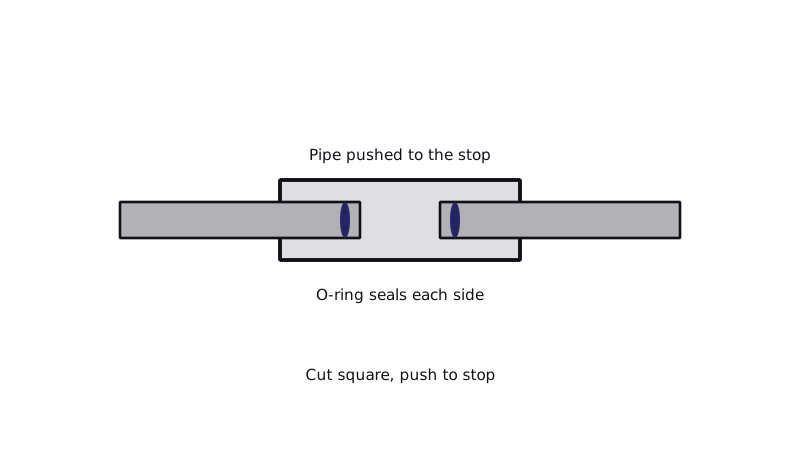
Yes. Push-to-connect fittings, SharkBite being one brand, can join copper, PEX-A, PEX-B, CPVC and PE-RT as long as the pipe end is cut square and plastic gets the proper insert. The fitting is indifferent to which PEX type it meets. They suit repairs, though they cost more than crimp or cinch fittings, and certain plumbers steer clear of them in hidden locations.
Before burying one inside a wall, check the manufacturer's directions along with local rules, since some jurisdictions limit concealed use and the area's plumbing inspector decides. A plumber can tell you what Temecula or the county accepts. They are a useful stopgap for a pinhole or crack, but a lasting repair is better made with a method the plumber trusts.
How do crimp rings and cinch clamps compare?
Crimp rings are copper bands pressed onto the fitting by a crimp tool; cinch clamps are bands of stainless steel drawn tight by a cinch tool. Installed correctly, both make a reliable seal on PEX-B. A go or no-go gauge verifies each crimp, whereas a single cinch tool handles several pipe sizes.
Expansion fittings for PEX-A work another way: the pipe is expanded, a ring is slipped on, and the pipe then shrinks back around the fitting. Whatever the method, the installer should check each joint, and the system should be pressure tested before the walls are closed. Cinch tools are cheaper and more versatile for a homeowner, yet a repipe belongs with a plumber.
Which material suits a Temecula home?
In an older tract home, PEX is often chosen for a whole-house repipe because of its speed, lower cost and fewer wall cuts, and it fits the 1980s to 2000s two-story homes common here. Copper suits exposed runs, hot spots near heaters, outdoor lines, and owners who prefer a metal system. Mixed systems are common.
Rural homes on a well, in Wine Country, Aguanga or De Luz for example, need a close look at the water: acidic well water can eat into copper, and sand or minerals wear any pipe. Get the water tested. The plumber can also say where copper stubs should go near the water heater and where PEX fits. For repipe permits, call the City of Temecula Building and Safety office at 951-694-6439, or the county if you live outside the city, and keep in mind that permitted work and jobs over $1,000 require a California contractor license.
How do I collect quotes for either material?
Request quotes for both materials covering the same scope, and have each plumber say which one they favor and why. Line up the fittings, warranty terms, wall repair and permit. Put your details on the quote page and we pass the request to a local plumbing business; the businesses that accept requests pay us a fee. Someone answers the phone on weekdays, 9am to 5pm.
What drives cost is covered in repipe house cost and the PEX repipe cost guide. Everything else we can arrange is listed on the Temecula Pipe and Repair home page.
Common questions
Is PEX approved for drinking water?
Under the plumbing code, PEX is approved for potable water when it carries the right marking. Look for the approval printed on the pipe, flush new lines, and buy from a reputable supplier. If you have a specific health concern, ask your water district and a doctor.
Is PEX suitable for outdoor use?
Not in sunlight. UV breaks PEX down, so it must be covered or buried, and manufacturers set limits on exposure during construction. For exposed outdoor runs, copper or another rated material is the usual choice. Check the product's rating before you use it.
Will PEX freeze and split?
Because PEX can stretch as water turns to ice, it often fares better than copper, yet it does not resist freezing entirely, and fittings can still split. Freezing is less of a risk in Temecula than in colder places, though higher-elevation areas such as Aguanga can see freezes, so insulate exposed lines.
Does a switch to PEX alter water pressure?
Not by itself. Next to copper in an identical nominal size, PEX has a slightly narrower bore, which plumbers allow for when sizing, and fresh smooth pipe frequently flows better than old galvanized or scaled lines. The street pressure and the regulator still set the pressure.
Does changing from copper to PEX need a permit?
For a repipe, generally yes. It counts as permitted plumbing work, and the permit usually includes an inspection. Check with City of Temecula Building and Safety, or with the county if the address is unincorporated, and make sure the quote states who pulls the permit.
Updated