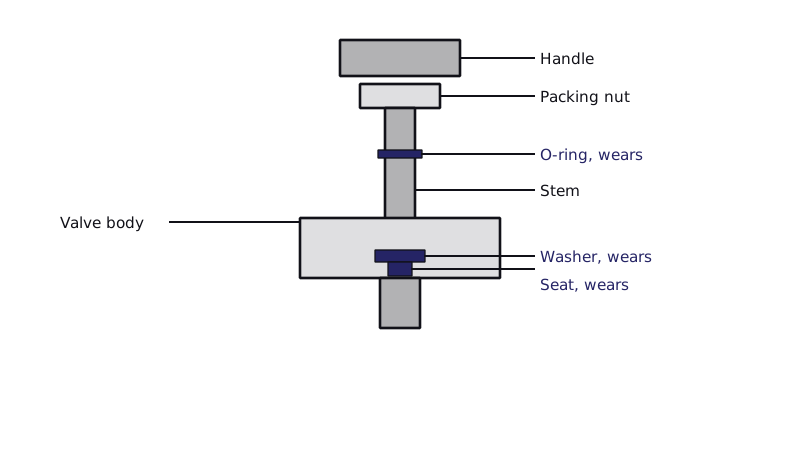
Behind a drip there is almost always a cartridge, seat, O-ring or washer that has worn out, and the repair follows the same pattern each time: close the supply, take the handle apart, replace the tired part, put it back. Under-sink supply valves make this a half-hour job for most people. Disposals and other sink gear sit in the same cabinet, covered under garbage disposal repair.
Which faucet design do you have, and why does that matter?
The mechanism inside decides which part to buy. Four designs cover nearly every home: compression faucets (separate hot and cold handles, rubber washers), cartridge faucets, single-lever ball faucets and ceramic disc faucets with a wide, smooth body. Identify yours before you buy anything.
A quick field test:
- Two handles that screw down tighter until they stop are usually compression.
- Two handles that turn a quarter or half turn only are probably cartridge or ceramic disc.
- One lever that rotates over a rounded cap is often a ball or a cartridge type.
- Delta is a brand with several of these inside, so check the box, the cabinet beneath the sink or the manufacturer's site for the model number before buying a kit.
If you cannot name the part, carry it to a hardware store counter. A matched replacement saves a second trip.
What do you do before opening any faucet?
Close the water to that one fixture, run the tap until it drains, and plug the drain. Turn the little oval valves on the two supply lines under the sink. If a faucet has none, shut the house main. The drain plug matters, because a dropped screw or retaining clip disappears down it for good.
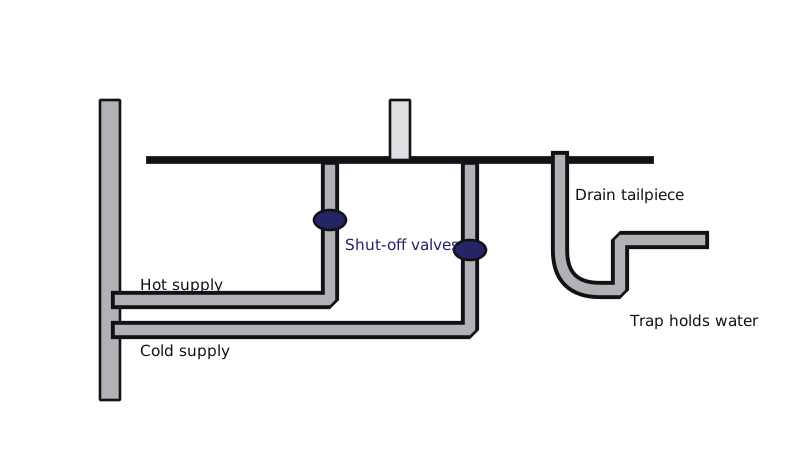
Lay a towel in the basin to protect the finish and to catch dropped parts. Photograph each stage as you unscrew things, since the order of rings, washers and caps is easy to forget. Keep every part in a cup in the order it came off.
If the stop valve beneath the sink will not turn or weeps from the stem when you try, stop there. Forcing an old valve is how a drip becomes a flood. A plumber should handle that, and it is a quick job.
How can a dripping bathroom or kitchen faucet be repaired?
Replace what wears. With a compression faucet, the parts to renew are the rubber washer and sometimes the brass seat. In a cartridge or ceramic disc design, they are the cartridge or the inlet seals. A leak from the spout is the valve itself. A leak from around the handle is usually the O-ring or packing nut.
For a two-handle compression faucet:
- Pop off the decorative cap and take out the handle screw.
- Raise the handle, loosen the packing nut, and pull the stem.
- Replace the washer at the bottom and the O-ring around the stem.
- If the seat inside the body is pitted, a seat wrench either dresses or replaces it.
- Put it back together, open the supply slowly, and run both handles.
For a single-handle cartridge, the cartridge pulls out as one piece after the retaining clip or nut is released. Match it to the old one by shape and by the number of splines. If the new one still drips, the seat inside the faucet body is scored, and a fresh faucet may cost less than the time you spend chasing it.
Kitchen faucets add a pull-down hose and aerator. A spray head that keeps dripping once the water is off is often debris in the head or a failed diverter, and the aerator unscrews to clean.
What repairs a leaky tub or shower faucet?
Because the valve is hidden inside the wall, you begin work from the handle. Pull the handle, then the trim plate, to reach the valve stem or cartridge, and replace that part the same way as at the sink. Many tubs have no stop of their own, so locate the house main before you start.
A tub that drips from the spout when the water is off has a worn cartridge or washer in the valve. A shower still dripping once it is switched off has the same fault. If water stains appear on a ceiling or wall below the bathroom, the leak may be inside the wall and not a worn washer. Treat that as a plumbing call, not a weekend repair, and look at leaks in the house for how those are tracked.
Many tub valves are sold in two or three common patterns, and an exact match depends on the maker. If the valve was never meant to be serviced from the front, tile may need opening, which is plumber territory. See also our guide to fixing a two-handle bathroom faucet for the detailed sequence.
What stops an outdoor faucet from leaking?
First work out where it leaks. A spout that drips has a worn washer, just like indoors. Water seeping from behind the handle points to the packing nut or a washer. Water that sprays out around the vacuum breaker cap while the hose is running can be a normal feature of some types, while a steady drip from the cap when the tap is off is not.
For a hose bib, shut the supply that feeds it. Some homes have a small valve for it in the garage or under the house, and others depend on the main shutoff. Next, loosen the packing nut, draw out the stem, and install a fresh washer along with a new O-ring. Keep hoses unplugged when you are not using them, since a hose holds pressure against the faucet and can mask a slow weep.
Gardens and rural lots in Temecula's outlying areas can have long irrigation runs. A drip at the hose bib that suddenly gets worse may mean the pipe behind it is damaged, so photograph the location of the water before you touch anything.
Cold snaps are rare in the city but they do occur in higher or more rural parts of the valley, and a frost-proof hose bib relies on a long stem that drains toward the outside. If a hose stays connected, water can sit in that stem. A cracked one leaks inside the wall when the tap is opened in spring.
Should I bother repairing a dripping faucet?
Yes, because water you never use still shows up on the meter. By the EPA's figures, the typical household leak wastes over 9,300 gallons a year, and a faucet is one of the simplest sources to fix. To put a number on it, read how a dripping faucet affects your water bill.
Much of the city is served by Rancho California Water District, while Eastern Municipal Water District supplies some Temecula addresses, so check your bill to learn which one you pay. Either way, a repair kit costs less than a season of drips. Hard water in the valley also leaves mineral deposits on cartridges and aerators, so scale can stop a seal from closing and set a faucet dripping.
At what point does a plumber need to step in?
Phone a plumber when the supply stop will not close, the faucet body is corroded or cracked, water collects in the cabinet while the faucet is off, or the model is a mystery to you. The same goes for a leak behind a tile wall, or a house with brittle older galvanized supply lines.
The visiting plumber from a local business turns off the water, swaps the part or the entire faucet, and checks the supply lines. Give us your details on the quote request page and we arrange the visit. That plumber works for a local business, which sets the quote itself and pays us a fee for the introduction. For a broader view before you decide, plumbing services across Temecula lists what can be arranged.
Common questions
Why does the faucet drip even after a new washer?
The seat is probably worn. Water squeezes past the new washer where the old one left a groove in the brass. A seat wrench can dress or replace it in many compression faucets. In cartridge faucets, a second drip after a new cartridge often means the cartridge is the wrong size or was not fully seated. Reassemble carefully before blaming the part.
Can I stop a leaking handle with plumber's tape?
Sometimes, but only on threads. PTFE tape helps seal threaded joints such as a spout swivel or supply connections. A handle leak is almost always an O-ring or packing problem, and tape will not seal that. Replace the O-ring with the right size and put a thin smear of plumber's grease on it before reassembly.
Why does water drip only when the faucet is turned on?
This typically means the stem or packing nut is leaking, because pressure only reaches those parts when the valve is open. The spout stays dry because the washer is sealing, but the water finds its way out around the handle. Try a light turn on the packing nut first, and if that does not help, change the packing or O-ring.
Is garbage disposal installation part of fixing a faucet?
No, it is a separate job that shares the sink cabinet. A disposal involves a sink flange, a drain hookup, electrical work and a mounting ring, and the dishwasher line may tie into it. A guide to the connection is at garbage disposal installation with a dishwasher.
How long should a faucet repair take?
A single-handle cartridge swap is often under an hour once you have the right cartridge, and a compression washer change is similar. Tub and shower valves take longer because of access, and tile or drywall repair adds to it. The longest part is usually finding the correct replacement, so photograph the faucet before you shop.
For the wider picture, start with plumber in Temecula.
Sources used
- EPA household leak figure (more than 9,300 gallons a year)
Updated