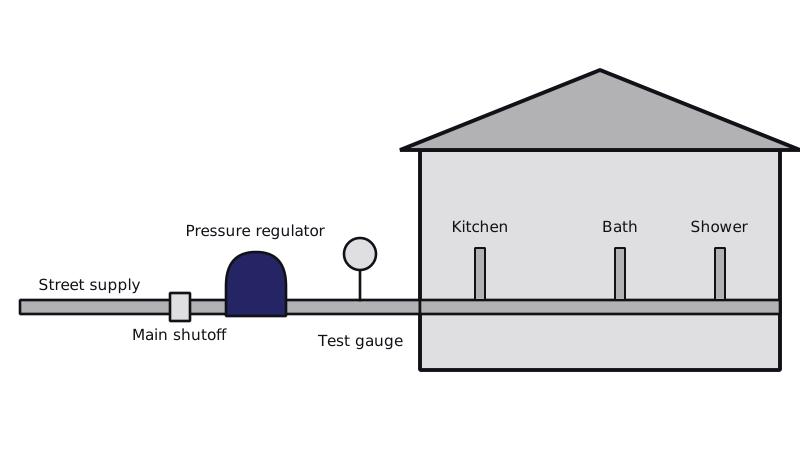
Begin by asking how many fixtures are weak. A single faucet or showerhead almost always means a clogged screen or cartridge. When every fixture is weak, the usual suspects are a buried leak, a change in supply beyond your property, the main shutoff, or the pressure regulator. We pass your request to a local plumbing business, which tests it with a gauge. Send it through the quote page, or read how the service works on the home page.
Does low pressure hit a single fixture or the entire home?
Check how many taps are affected. If only one is weak, unscrew its aerator or showerhead and rinse out the grit. Weak hot but strong cold points to the heater or its valves. If everything is weak together, the cause lies upstream, and cleaning screens will not help.
Temecula tap water is very hard. Rancho Water's own reports put average hardness around 230 to 240 mg/L in the 2020 to 2023 reports, about 13 to 14 grains per gallon; check the current report on its website. That mineral load builds crusts inside aerators and showerhead plates, and it is why many local weak-spray complaints end with a vinegar soak. See preventing scale from hard water for the longer routine.
A quick sorting guide:
- One shower weak: clogged nozzle plate or a flow restrictor. Our note on a showerhead for low pressure covers swaps.
- Hot side weak only: partly closed heater valve, sediment or a failing mixing valve.
- Whole house weak, sudden: a main valve left shut or partly shut, a regulator that failed, or a leak. Read what to check when pressure drops suddenly.
- Weak only in the farthest rooms: long runs of narrow or corroded pipe.
Where does the pressure regulator sit, and what is its job?
Look for a brass valve shaped like a bell, usually near the hose bib or main shutoff, around the point at which the supply line comes into the house. In Temecula it is often found in a front-yard box, mounted on a garage wall, or beside the water heater. Its job is to bring street pressure down to a level your pipes tolerate, and a failure can make pressure sag or surge.
When you have no luck locating it, the plumber can follow the main line to it within minutes. Some houses on high-pressure streets have none, and others have a regulator buried in an enclosure. You can see how the adjustment works in adjusting a pressure regulator, but replacing it is a plumber job, and a new one is covered in pressure regulator replacement.
What pressure is normal in a house?
Under the California Plumbing Code, household pressure may not exceed 80 psi, which is why a regulator is expected wherever the street runs higher. Below that cap, roughly 50 to 70 psi feels comfortable to most people. Read your own pressure by threading an inexpensive gauge onto an outside spigot while nothing else is running.
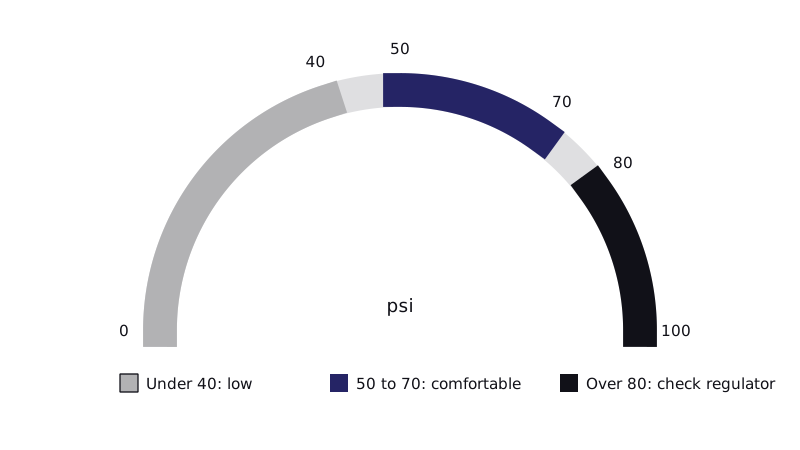
The numbers matter beyond comfort. InspectApedia lists supply pressure over about 70 psi as a cause of water heater relief valve leaks, and high pressure also tends to wear taps and fixtures sooner. Low readings, under about 40 psi, make showers dribble and dishwashers fill slowly. A reading that swings by 20 psi or more over a day often points to a failing regulator rather than to the supply.
How many years can I expect from a regulator?
No set lifespan exists; many run for a decade or two, and hard water and spikes shorten that. Signs one is tired include pressure that creeps above 80 psi, pressure that falls over time, a humming sound, or banging pipes when taps shut. The Wikipedia entry on water hammer lists a failing regulator among the causes of that banging.
If your house is old enough that the regulator is original, replace it before it fails, since a stuck-open unit sends full street pressure through supply lines, toilets and the heater. Cost per job is a quote item. Regulator installation cost explains what pushes the price up.
Is a fix for low pressure a leak job, too?
Sometimes. A leak ahead of the faucets steals pressure, so a plumber checks for a running meter with every fixture off. If the dial still turns, water is escaping somewhere. Slab leaks, buried irrigation breaks and pinholes in old copper are common culprits, and a plumber can locate them. We cover leak repair as its own service.
When requesting a visit, mention a damp patch or an unusually high water bill; either detail tells the plumber to begin with the supply line instead of the fixtures.
Why does pressure fall at certain times, and what about sprinklers?
Pressure often sags when demand peaks, such as summer evenings when irrigation systems and showers all run together. Sprinklers feel it first, because heads rely on steady pressure to rise and spray evenly. If lawn zones are weak but the house is fine, the problem is usually a partly open valve, a clogged filter or too many heads on one zone.
For a house with a sprinkler system, a plumber can inspect the irrigation line's backflow device, since a stuck one chokes flow. Cold weather is a lesser concern in town but a real one in Aguanga, where a frozen line can cut flow without bursting.
Does low water pressure do any damage, and is it linked to blood pressure?
Low pressure does not harm pipes. It does harm showers and appliances: washers fill slowly, and a tankless water heater may not fire below its minimum flow. Low pressure can also hide a leak. "Water" and "blood pressure" share a word but nothing else, and for health questions you should ask a doctor rather than a plumber.
Common questions
Why do plumbers sometimes steer people away from tankless?
Not all do. Tankless units need a gas line sized for their burners, a vent run and regular descaling, and hard water makes that last point serious in Temecula. The upfront price is also higher. The tank versus tankless comparison sets the pros and cons side by side.
What does swapping a water heater run?
It depends on tank size, fuel type and how the old unit is plumbed. National guides give only a broad range, so read water heater replacement cost for what moves the price, and request an itemized quote from the plumber. Fixr lists plumber labor of $75 to $150 an hour as typical.
How long does water heater replacement take?
Exchanging one tank for a like one often eats most of a day, and a switch to tankless takes longer because of venting and gas work. Expect no water for several hours. Inside the Temecula city limit, the Building and Safety office usually requires a permit for the change, so ask who obtains it.
What does a new pressure regulator cost?
The part is modest, and the quote is mostly labor plus any trouble reaching the old unit. A seized fitting or a regulator buried in a landscaped box adds time. Price the job as a service call plus a short repair, and have the plumber measure pressure before and after.
Does a water heater need its own regulator?
Not separately, but high supply pressure shortens a heater's life and can trip its relief valve. When the main carries a regulator or check valve, heat expansion can push pressure up while the heater runs, so an expansion tank is often needed to absorb it. A plumber can verify this with a gauge.
Guides in this section
- Adjusting a regulator
Find your pressure regulator, test the psi with a gauge, turn the adjusting screw the right way and know when the valve is worn out and a…
- Showerhead for low pressure
How to pick a showerhead for low water pressure in a Temecula home, what California flow limits mean, and how to tell a scaled head from a…
- Sudden low water pressure
Pressure dropped overnight? A quick triage for Temecula homes: outages, closed valves, leaks, clogged filters, regulators and wells, plus…
- Water pressure regulator replacement
When a water pressure regulator fails, symptoms, how to test pressure, what replacement involves, permits and when to call a Temecula…
- Causes of low pressure
The common causes of low water pressure in a house, how to read the signs, which are quick fixes and which need a plumber, with Temecula…
- Costs
What decides the cost to replace or install a water pressure regulator in Temecula, how to read a quote line by line and what to ask…
- Water pressure and valves
Low water pressure at home in Temecula usually traces to a valve, regulator, clogged line or leak.
Updated