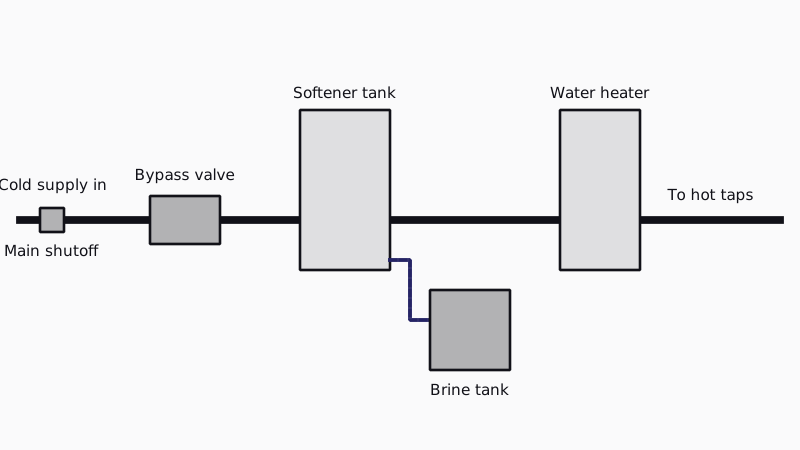
Inside a softener, sodium or potassium takes the place of the calcium and magnesium in your supply. The pipework around it has to be done right: inlet and outlet lines, a bypass, power for the control head, and an air-gapped drain. To have a local plumber fit a unit you bought, or advise before you buy, begin with the quote form. The form sends your request to a local plumbing business; the businesses taking requests pay us a fee.
Rancho Water's own reports put average hardness near 230 to 240 mg/L, roughly 13 to 14 grains per gallon, in the 2020 to 2023 reports. That is hard enough to crust a kettle in weeks and to scale up the tank inside a water heater. If your bill comes from a different district, check its current Consumer Confidence Report, because supplier and street both matter.
What work does the plumber carry out on a softener hookup?
First the plumber chooses a location close to where the main supply enters, commonly the garage or a utility strip beside the house, then closes the water and cuts into the pipe. After that the plumber fits a bypass valve and the tank connections, runs a drain line for the regeneration water, and finds a place for the power cord. Once the hardness is set, the plumber flushes the system, checks for leaks and walks you through the controls.
Placement matters more than people expect. The unit belongs after the main shutoff and any pressure regulator but before the water heater, and outdoor hose spigots are often left on untreated water. Some tract homes already contain a softener loop, a capped branch of pipe stubbed out for the equipment, which makes the job quicker. Ask a plumber to find it before you assume new cuts are needed. For the step-by-step view, open the softener installation walkthrough.
Does a house need a softener loop, and what is one?
Some tract homes have a softener loop: a U of pipe, often fitted with shutoff valves, built into the garage wall ahead of time. It allows a softener to be connected later with no cut into the main line. Not every house has one, and older houses frequently do not.
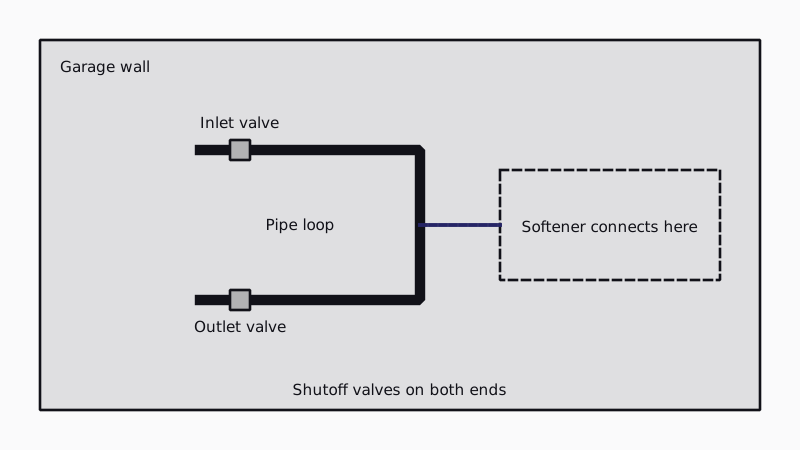
Where there is no loop, the plumber adds the connections, typically with copper or PEX fittings and a bypass. A loop with the water running through it should have no leak and no corrosion at the valves. If yours has sat unused for years, test the valves before installation day. Mixed pipe materials need proper dielectric or transition fittings, because copper and galvanized steel in contact corrode each other.
What affects the price of fitting a softener?
Three things drive it: the condition of the plumbing already in place, how far the supply sits from the drain, and the equipment itself. The easy case is a home that has a loop and a standpipe close by. Labor rises with a long drain run, a cut into aging pipe, or electrical work to bring power. The plumber gives the real price after viewing the site.
No price range appears on this page. We found no published figure that we could verify against a source, and softener prices swing with the equipment chosen. For a breakdown of the usual factors, see water softener installation costs in Temecula.
How can you tell you need a softener?
The classic signs are white scale on faucets and shower glass, a dull film on dishes, soap that refuses to lather, stiff laundry, and a rumbling water heater. Scale inside pipes also cuts flow. A hardness number from a test strip at home or from a lab can be compared with your supplier's report.
Temecula's municipal water is blended from local groundwater and imported supply, so hardness moves around. Private wells in the valley and in the rural areas around Aguanga or De Luz vary well by well, and they should be tested rather than guessed. Cleaning advice is in hard water scale prevention, while water use is covered in what a softener does to your bill.
Are there downsides, and do any local rules apply?
Softeners use water and salt to regenerate, and Rancho California Water District says on its FAQ that softeners generally waste more water than they treat, because the system must be flushed, and that the salt byproducts end up in wastewater treatment and groundwater. Some areas restrict or discourage salt-based units, so ask the plumber and the water district what applies to your address.
The drain connection must include an air gap too, which stops wastewater from siphoning back. Tell the plumber if the home runs on a septic system, since brine discharge is a known concern there. Salt-free conditioners avoid the discharge but work on scale formation, not on removing hardness, so compare claims against what you actually want from the water.
Will a softener fit with a shower head or a brine tank?
Do not confuse a shower head filter with a softener. The filter can cut chlorine but leaves calcium in the water. Only a whole-house softener treats the water at every tap. The brine tank is a separate reservoir, sometimes in one cabinet with the resin tank and sometimes alongside it, that holds salt and the brine used to recharge the resin.
Keep the brine tank on a level surface, with its overflow line routed to a drain. Leave room to lift the lid and pour in salt bags, and check the salt level every month or so. Putting it on a shelf or tight in a cupboard makes refills awkward and speeds up neglect.
Can the plumber install a Culligan, Kinetico, Aquasana or Whirlpool unit?
The plumbing is similar across brands: inlet, outlet, bypass, drain and power. The control head and mounting vary, so the plumber works from the maker's manual for your model. We do not sell these brands, and nothing on this page ranks one above another. Have the model number and the manual to hand, or ask the plumber which unit suits your supply.
Rental and dealer-supplied systems sometimes bundle installation into the deal. When you bought the unit elsewhere, mention it in your quote request so the plumber prices labor alone.
Common questions
How much time should a softener installation take?
Where a loop exists, a simple swap can finish in around two hours. A new installation needing pipe cuts, a drain run and power takes longer, maybe half a day. The water goes off during part of the visit, so schedule showers and laundry elsewhere, and request a time window from the plumber when booking.
What should I ask a softener installer before hiring?
Find out what the written price covers: the drain run, bypass, fittings, packaging disposal and any permit. Ask who is responsible if an old valve fails during the job, and how the hardness will be set. Ask whether the house has a loop, and whether pressure is checked after the work.
Does an adult need to be around while it is installed?
Yes, at least at the start, to point out the main shutoff and the preferred spot, and at the end, to learn the settings. Many people stay throughout, as the water is off and the plumber may need access to the garage and the outdoor drain points.
Does installing a softener need a permit?
It depends on your city or county and the scope of work. Some jurisdictions treat a softener hookup as minor, and others want a permit when pipe is cut or a drain is changed. Before the plumber starts, call the City of Temecula Building and Safety division on 951-694-6439, or the county covering your parcel.
Is a softener worth it in Temecula?
It depends on what you want from the water. If scale is shortening appliance life or leaving fixtures coated, a softener addresses the cause, though it adds a salt cost and a maintenance habit. Some residents choose a smaller scale-control device, or only a water heater flush routine. Compare costs on the cost page and on the softener service guide; other services appear on the home page.
Guides in this section
- Water softeners and treatment
A water softener adds some water use at each regeneration, but a big jump in the bill means a fault.
- Hard water scale prevention
Why scale builds up in Temecula pipes and heaters, what ppm and grains per gallon mean, and the options that prevent it, from softeners to…
- Installing a water softener
Hooking up a water softener yourself in Temecula: the order of work, drain and bypass details, sizing for 13 to 14 grain water, and where…
- Water softener installation service
What a softener installation service covers: site checks, bypass, drain and air gap, well water, manuals, local discharge rules and how to…
- Costs
What decides the price of a water softener installation in Temecula: the unit, loop, drain, power, permits and hard water, and how to…
Updated