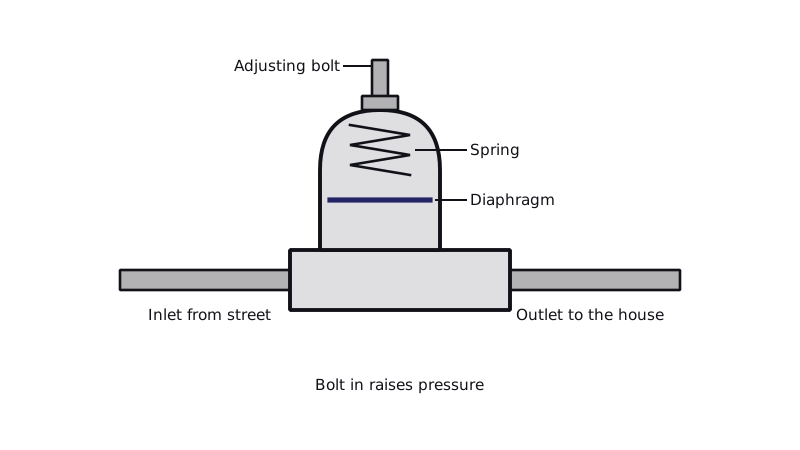
All you need to adjust a pressure regulator is a gauge, a wrench and a few minutes, and it only pays off when the valve is healthy. Turn the adjusting bolt in to raise pressure and out to lower it, one quarter turn at a time, reading the gauge after each. If the number will not hold, the valve has worn out. Other causes of weak flow are on the low water pressure page.
Where is my water pressure regulator valve?
The regulator is normally a bronze, bell-shaped valve fitted to the main water line right after the shutoff, near the spot where the pipe comes into the house. In many Temecula homes it sits in the garage next to the water heater, in a box along the side wall, or in a ground-level bonnet out front. Plenty of older homes have none.
Look for a fist-sized brass body with an adjusting bolt and a locknut at its top. Some tracts place it in a meter-side box owned by the water utility, and anything upstream of the meter, on the utility's side, is not yours to touch. Rancho California Water District supplies much of Temecula, and Eastern Municipal Water District supplies parts of the area, so your water bill tells you which one is yours. If the main has no bell valve behind the shutoff, ask the plumber whether street pressure in your area is high enough to need one.
What does the regulator do inside?
A spring-loaded diaphragm lives in the bell. Strong street pressure drives the diaphragm back against the spring, which narrows the passage through the valve. As the house draws water, downstream pressure drops, the spring opens the passage wider, and flow increases. The adjusting bolt changes how tightly the spring is set, so it sets the pressure the valve will hold.
That is why a regulator leaves pressure steady when street pressure swings. It also means that a regulator ages: the diaphragm hardens and the seat wears. Fine grit and scale in hard water make it worse, which is a regular issue in Temecula's very hard water. The valve lasts many years, but it does not last forever, and plumbers commonly see failures at the 10 to 15-year mark. Take that as a rough guide rather than a rule.
Which pressure setting is right?
Aim for roughly 55 to 65 psi at a hose bib; the California Plumbing Code sets the cap at 80 psi. Going past 80 psi stresses fixtures, supply lines, the water heater and appliance valves. Below about 40 psi, showers feel weak. Take the setting from a gauge reading every time, never by feel.
Thread a hose-fitting pressure gauge, sold at any hardware store, onto an outdoor hose bib, close every tap inside, and note the static pressure. That is the base number to compare against. Then draw water from a bath or a hose and watch how far it drops. A large drop under flow means a clogged or failing regulator, or a restriction elsewhere.
What are the steps for adjusting the valve?
Make sure the gauge is connected, then slacken the locknut at the top of the valve. Rotate the adjusting bolt in a clockwise direction for higher pressure, or counterclockwise for lower, a quarter to half turn per move. Run a tap briefly so the new setting registers, read the gauge, and repeat until you reach the target. Finally retighten the locknut.
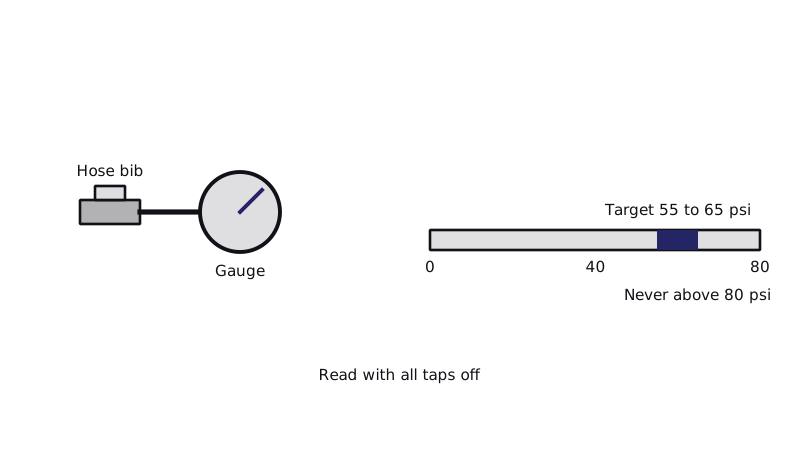
- Gauge on a hose bib, all taps off, note the starting psi.
- Loosen the locknut with a wrench; do not remove the bolt.
- Turn the bolt a quarter turn and let a tap run briefly.
- Look at the gauge again. Pressure settles slowly, so wait a minute.
- Keep repeating until the reading matches your target, then tighten the nut.
- Recheck an hour later, and again the following day.
Two warnings. If the pressure number creeps upward over an hour with every tap closed, either the valve is failing or the water heater is expanding in a closed system, and an expansion tank may be needed. And if turning the bolt changes nothing, stop: the diaphragm is probably shot.
What can I do about low pressure at home?
Find the cause first. A single weak tap suggests the fixture or a clogged aerator. Weakness at every tap suggests the main valve, the regulator, corroded pipe or the street supply. A gauge reading of 40 psi or better at the hose bib alongside weak showers means the fault is inside the house.
Check that the main shutoff is fully open, since a half-open gate valve is a frequent cause. Clean aerators and shower heads of scale. Pull a flow rate: fill a one-gallon bucket at an outside tap and time it. Galvanized pipe, common in older homes, narrows with rust over time, see galvanized pipe replacement. When no cause shows up, the low pressure causes list the rest of the checks.
Can I replace or install a pressure regulator myself?
A valve swap means cutting into the main line beyond the shutoff, and most homeowners hand that job to a plumber. Work on the main supply may require a permit, and California demands a contractor license for anything needing a permit or costing $1,000 or more. Ask City of Temecula Building and Safety on 951-694-6439, or your county office if you live outside the city.
Doing it yourself is possible with unions or compression fittings, but you must close the line at the meter or main, drain it, and match the connections to your pipe, be it copper, PEX or galvanized. Mistakes become floods. If you are comparing prices, regulator installation costs explains what drives them.
Are showerhead, hose and pump regulators the same thing?
No, they are separate devices. A showerhead regulator is a flow restrictor inside the arm or head, a hose regulator caps pressure on a hose or sprinkler line, and a pump pressure switch decides when a well pump starts and stops. None replaces a house regulator. Wine Country, Aguanga and De Luz well pump systems have their own pressure settings.
A Watt regulator is simply one common brand of house regulator, and so are Zurn, Wilkins and Cash Acme. The brand matters less than the inlet size and connection type. With a well, the pressure is set by a pressure tank and a switch, and the adjustment is on the switch, not on a bell valve.
When should a plumber do this?
Call a plumber if the regulator is leaking, if pressure spikes above 80 psi when taps are closed, if the bolt turns without changing the reading, or if you have no regulator and high pressure. Ask at the same time about an expansion tank, because the two are often fitted together.
Enter the details on the quote page. We forward your request to a local plumbing business, which then contacts you, and the businesses that accept requests pay us a fee. The phone line is staffed Monday through Friday, 9am to 5pm. The home page shows other work we arrange.
Common questions
What is the usual lifespan of a pressure regulator?
Plumbers commonly see regulators wear out somewhere in the range of 10 to 15 years, and hard water or debris can shorten that. Signs include pressure creeping above 80 psi, pressure falling under flow, banging pipes, a leaking bell or a relief valve that keeps dripping. The easiest check is a gauge screwed onto an outdoor hose bib.
Which way do I turn the regulator to increase pressure?
Clockwise (in) on the adjusting bolt raises the setting, and counterclockwise (out) lowers it. Make changes of a quarter to half a turn, run a tap to let the pressure register, and read the gauge you attached outside. Typically each turn shifts the pressure by a few psi, so go slowly.
Why does my water pressure go up and down?
A failing regulator is one cause, because the diaphragm or seat no longer holds a steady setting. Other causes include shifts in street pressure, a main valve left partly open, a leaking fixture, or thermal expansion at the water heater. A gauge reading over time shows which. If it swings with every tap, the valve is the likeliest culprit.
Is a permit needed when a regulator is replaced?
That depends on the job. A valve swap on the main line frequently counts as plumbing work for which the city or county can demand a permit, and permitted work in California is reserved for a contractor holding a state license. Before starting, ask City of Temecula Building and Safety, or the county if you are in an unincorporated area.
Can a home without a regulator have one added?
Yes, the plumber can fit one behind the main shutoff, ideally with a gauge. Homes above 80 psi gain the most. The plumber will also judge whether a water heater calls for an expansion tank, and whether a well system needs a different valve instead.
Sources used
- California Plumbing Code, section 608.2 (80 psi pressure limit)
- Rancho California Water District
- City of Temecula, Building and Safety
- California Contractors State License Board
Updated