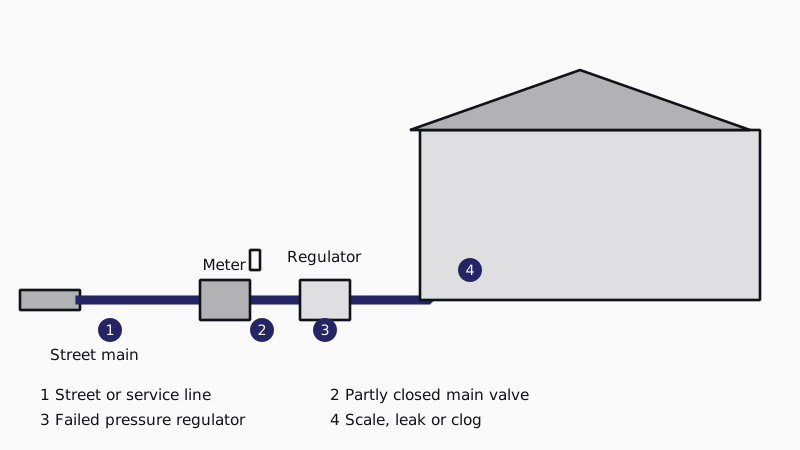
Typical culprits behind weak pressure are a valve left partly shut, a failing pressure regulator, a clogged fixture, a hidden leak, scale or corrosion in the pipes, or trouble on the utility side. Where the weakness appears narrows it down. Our main page on low water pressure in Temecula explains what a plumber checks, and this guide sorts the causes by sign.
Which symptoms show that pressure is too weak?
The signs are a weak stream at faucets and showers, a washing machine or dishwasher that fills slowly, a toilet that refills slowly, water that dwindles when two fixtures are used together, and spray that sputters or surges. A sudden drop points to a valve, a leak or a utility problem, while a slow decline over years suggests scale or corroded pipe.
Notice which fixtures are weak. If only one tap is affected, suspect that tap's aerator, cartridge or supply. Hot water alone, with cold normal, implicates the hot lines, the water heater or its valves. Weakness across the whole house implicates the service line, the regulator, the main valve or the supply itself. Time of day matters too: pressure that drops in the evening may reflect demand on the street.
Appliances give early notice. Fill times on a washer, a dishwasher or an ice maker stretch before you notice it in the shower. If a faucet also runs noisy or the pipes bang, the cause could be pressure that is too high rather than too low, which wears parts out. Both deserve a gauge reading.
What causes sudden low water pressure?
A sudden drop most often traces to a valve left shut or half shut after recent work, a regulator that has given out, a leak on your line, or a utility outage or street repair. Make sure the main shutoff and the valve at the meter are open all the way, look for wet ground or a spinning meter with all fixtures off, and ask neighbors whether their pressure changed.
Start with the easy checks. Has any plumbing work, water heater swap or softener installation happened lately? A stop valve left partly closed would do it. Is any fixture leaking or running? Does the meter move when everything is off? Moving dials mean a leak somewhere downstream, and a leak can reduce what reaches the taps.
If your neighbors are affected, call the water district. Many Temecula addresses are supplied by Rancho California Water District, while Eastern Municipal Water District covers parts of the city, so check your bill before you call. Eastern's retail area also includes unincorporated Winchester. If you are in Fallbrook, the district may be Fallbrook Public Utility District or Rainbow Municipal Water District. A main break or flushing program can cause a short pressure dip.
Never open the main shutoff while a pipe is burst. If water is pouring out and pressure has vanished, close the main shutoff and read our guide on how to tell if a pipe has burst.
Could a regulator or aging pipe be the reason?
Yes. A malfunctioning regulator can hold pressure well below what the street delivers, and old galvanized steel pipe narrows inside as rust and scale build up, so even a strong supply arrives as a trickle. The ceiling at a building is 80 psi under the California plumbing code, which is why many homes have a regulator near the entry, and it wears out in time.
A regulator problem often hits the entire house together, and sometimes appears as pressure that creeps up and down. Replacement belongs to a plumber; our guide to adjusting a regulator and the page on what installation costs cover it.
Pipe age matters. Rancho California tract homes from the late 1960s onward may have early copper, and some homes of that age raise repipe questions. Older galvanized pipe, where it exists, is a known cause of restricted flow. Age alone does not reveal what your house contains, so a plumber should look. If you are weighing a repipe, see repiping a house in Temecula.
Over the years, hard water also leaves scale inside pipes and fixtures. Rancho California Water District's own reports put average hardness around 230 to 240 mg/L, roughly 13 to 14 grains per gallon, in the 2020 to 2023 reports. That is very hard water, so scale at aerators, showerheads and shutoff valves is common. Check the current Consumer Confidence Report at ranchowater.com.
What causes low pressure at only one faucet or only upstairs?
When a single faucet is weak, look for a worn cartridge, a clogged aerator, an under-sink stop valve that is only half open, or a kinked flexible supply line. Unscrew the aerator, rinse out debris and scale, and check the stop. Upstairs-only weakness is partly physics: pressure falls with height, and a two-story house loses some at the top, so a bit of difference is normal.
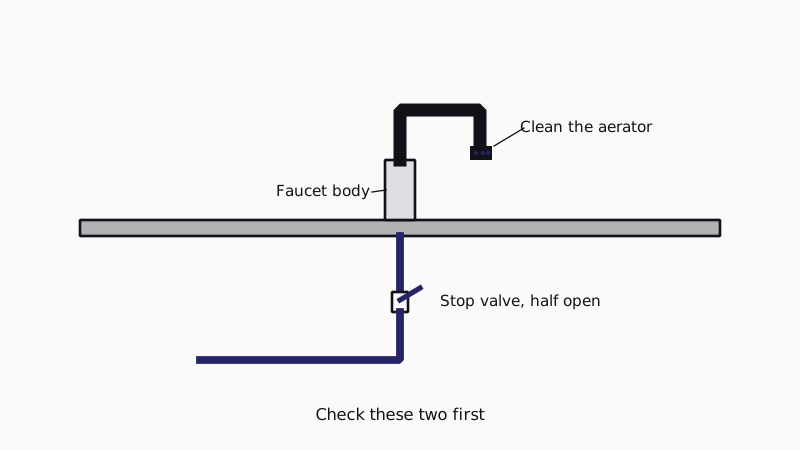
A bigger gap between floors suggests restricted pipe or a regulator set low. If just the hot side is weak, examine the water heater for a partly closed valve, sediment or a clogged heat trap. For the kitchen sink in particular, see a weak kitchen sink flow. For showers, see choosing a showerhead.
For houses on wells, in places such as Wine Country, Aguanga and parts of De Luz, low pressure also comes from the pump, the pressure tank, the pressure switch or a clogged well filter, and a well running low in a dry season. We have no figures to give for these systems, and the right settings depend on the equipment. A well pump is a job for a well or pump specialist, so ask the plumber who they work with.
When is weak pressure a job for a plumber?
Call one if the whole house is weak, pressure fell abruptly with no street-side reason, the meter turns with every fixture off, you see wet spots or hear running water, or you have checked valves and fixtures with no improvement. Call as well before adjusting a regulator or touching a well system, since both can damage pipes.
A plumber measures pressure with a gauge, checks the regulator and main valve, and looks for leaks and restricted pipe. If a repipe or regulator replacement is on the table, a written quote helps. To ask for one, request a quote and describe which fixtures are weak and when it began. Rural and unincorporated parcels may be near wells and septic, so mention if yours is.
Common questions
How long does it take to find the cause of weak pressure?
A simple check with a gauge, the valves and a few fixtures often takes under an hour. Tracing a hidden leak, a restricted pipe or a well problem can take longer. A plumber should tell you what they will test and what could change the price before they start, and give you a written result.
Which questions should I put to a plumber about weak pressure?
See that the quote covers the pressure test and the call fee, what will be inspected, what changes if the cause is a regulator or leak, and if a permit applies in California. With a well, ask who deals with the equipment. Have the repair price in writing before work starts.
Must I be at home for the visit?
Yes, or an adult you trust, since the plumber has to reach the main shutoff, the regulator, the water heater and sometimes the meter, and someone must approve the price. Open gates and clear the path in advance. If nobody can attend, settle the cost by phone and request a photo report.
Is low pressure bad for my appliances?
It can be. Dishwashers and washing machines need enough pressure to fill and rinse correctly, and some tankless water heaters will not fire below a minimum flow. Pressure that is too high is also harmful, because it wears out fixtures and supply lines. A gauge reading tells you which problem you have, so measure before you spend on parts.
This guide is one of many on plumber temecula.
Updated