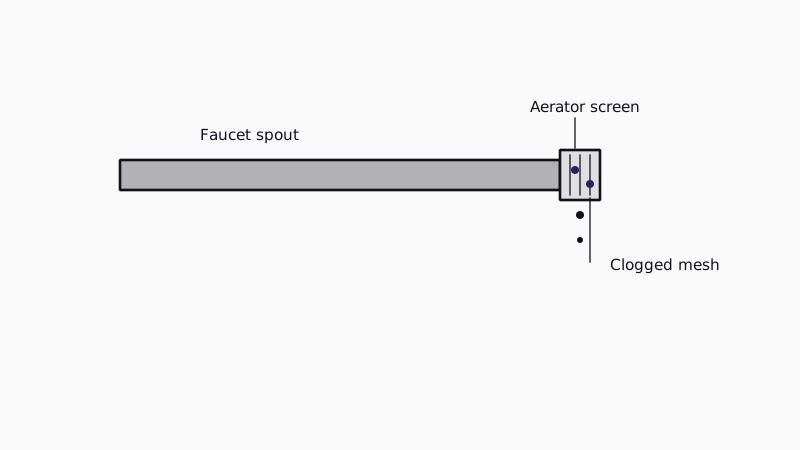
Take the aerator off the tip of the faucet and run the water. If the stream snaps back to normal, scale or grit in the screen was the cause. If not, check the two angle valves under the sink, then the sprayer and any filter. Faucet, sink and disposal jobs are grouped together on the garbage disposal and faucet repair page.
What makes the water pressure weak at just the kitchen sink?
One weak fixture points to that fixture or its own supply lines. The usual causes are an aerator that has clogged, an angle valve left partly shut under the sink, a kinked supply hose, a clogged cartridge, a blocked pull-out sprayer diverter or a filter that needs changing. Whole-house pressure problems usually show up at the shower and other taps too.
First, compare with another tap: turn on the shower and the bathroom faucet. If those flow strongly, the kitchen faucet or its lines are at fault, and the checks below will find it. If everything is weak, jump to the section on the whole house, because fixture work will not help.
How do I clear a blocked aerator on the faucet?
Unscrew it by hand, or grip it with pliers padded by a rag, then lift out the screen and washer and rinse off the grit. Leave scaly parts in white vinegar for roughly an hour, scrub them and put everything back. Aerators in this area clog regularly: Rancho California Water District's own reports have put hardness around 230 to 240 mg/L, so scale builds up fast.
Let the faucet run for a moment without the aerator to flush any loose debris out of the spout. If grit keeps appearing, the cause may be sediment from a disturbed line or a failing water heater, and the hot side may be worse than the cold. A bit of plumber's tape on the threads when you refit stops drips at the aerator.
When does this need a plumber?
Call one if a cleaned aerator and fully opened valves change nothing, if valves or hoses leak, if the entire house is weak, or if the lines show corrosion. During a single visit the plumber can swap the faucet, valves and supply lines, and read the pressure with a gauge to expose the real cause.
Pass along your findings via the quote page. We send each request to local plumbing businesses, which pay us a fee for them. The phone line is answered Monday through Friday, 9am to 5pm. The Temecula Pipe and Repair home page lists the other jobs we arrange.
What about a pull-out sprayer, filter or softener?
Pull-out and pull-down faucets contain a hose, a weight and a diverter. Debris in the diverter or a kinked hose can cut pressure from the spout while the spray works, or the reverse. Flow also drops when the cartridge in a reverse osmosis unit or an under-sink filter is clogged, and a dedicated drinking-water faucet is slow by design.
If you added a filter, change its cartridge on schedule or bypass it briefly to test. A water softener in bypass or a clogged softener resin can also change flow. If the kitchen was recently renovated, ask whether a flow restrictor was left in the new faucet. Check the faucet's cartridge too: single-handle faucets can have a worn or scale-blocked cartridge that restricts flow, and fitting a matching replacement usually fixes it.
Could it be the whole house, not just the kitchen?
Yes, if shower and bathroom taps are weak as well. The cause then lies with the main valve, the regulator, corroded supply pipe or the street. Older homes with galvanized supply lines are prone to narrowed pipes. A reading below 40 psi on a pressure gauge at an outside hose bib means supply trouble, while a normal reading means the problem is local.
Work in this order: put a gauge on a hose bib, confirm the main shutoff is fully open, then inspect the regulator. Guidance for the regulator is in adjusting the pressure regulator valve, and causes are listed in the page on reasons for weak water pressure. If the pipes are old, galvanized pipe replacement explains the repipe route.
What if the angle valves under the sink are the problem?
Check them. Each faucet line has a small shutoff valve, and they are often only partly open after earlier work or have a worn washer inside. Turn each handle fully open, then test the flow. If adjusting one improves the flow, that valve was throttling it. A valve that is stiff, weeps or has green corrosion should be replaced rather than forced.
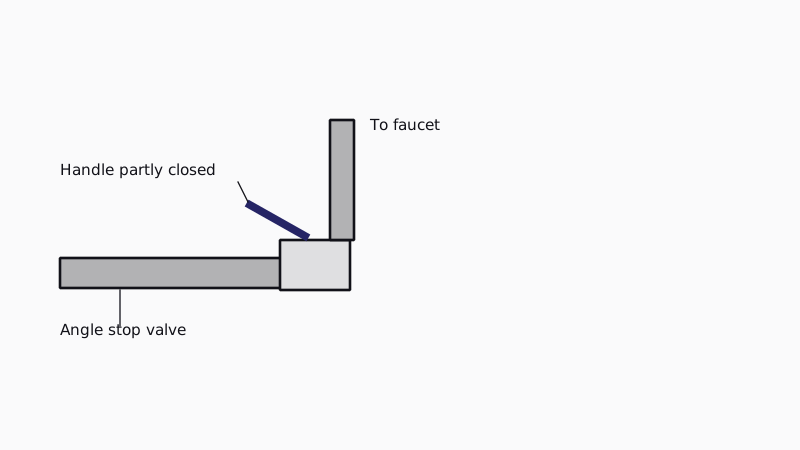
The flexible supply hoses under the sink can kink when someone stores items in the cabinet. A hose bent at a sharp angle cuts flow. Straighten it, or replace the hose if it is old, bulging or crusty at the nut. Old angle valves can fail when turned, so know where the main shutoff is in case one begins to leak. Swapping both valves and hoses is a standard small plumbing job.
Could the disposal or dishwasher be the cause?
Not directly. A garbage disposal and a dishwasher drain and do not affect supply pressure at the faucet. Two things can mimic it, though: a dishwasher running at the same time draws water from the same line, and a leak at a dishwasher supply or an ice-maker line under the sink can lower pressure at the kitchen faucet.
Look under the sink for dampness, rust on valves and any drips. A small leak on a shared kitchen line is both a pressure issue and a damage risk. If you spot one, shut that valve and call a plumber. A leak that has gone on for some time is also worth checking against your bill, because hidden leaks inflate water use.
Common questions
Why is the kitchen faucet weak when the bathroom ones are fine?
The trouble sits in the kitchen faucet or its supply lines. Scale in the aerator, a half-open angle valve, a kinked hose or a clogged cartridge are the usual causes. Clean the aerator first, then check the valves under the sink. If both are fine, the cartridge or the faucet itself may need replacing.
What causes weak hot water alone at the kitchen sink?
Hot water carries more scale, so the hot side clogs first. The hot angle valve, a scaled cartridge or sediment from the water heater can restrict flow. If hot is weak at other taps too, the water heater outlet or hot lines are the likely cause, and the heater may need a flush.
Can I clean the faucet without calling a plumber?
Yes, aerators and cartridges can be cleaned or replaced by most people with basic tools. Close the water at the angle valves before you open a cartridge. Should a valve refuse to close or parts be corroded solid, stop at that point and phone a plumber to prevent a leak.
Does low kitchen pressure mean a leak?
It can, if the drop is sudden or you see damp under the sink or a rising water bill. A leak between the main and the faucet lowers pressure, but a clogged aerator is far more common. Dry the cabinet, wait, and look for fresh moisture to tell the two apart.
How much pressure should a kitchen faucet have?
Household pressure is normally in the 40 to 80 psi range, with 80 psi as the limit under the California Plumbing Code. Many aim for the 55 to 65 range. A faucet's flow also depends on its design, so a low-flow faucet will feel weaker than an older one even at the same pressure.
Sources used
Updated