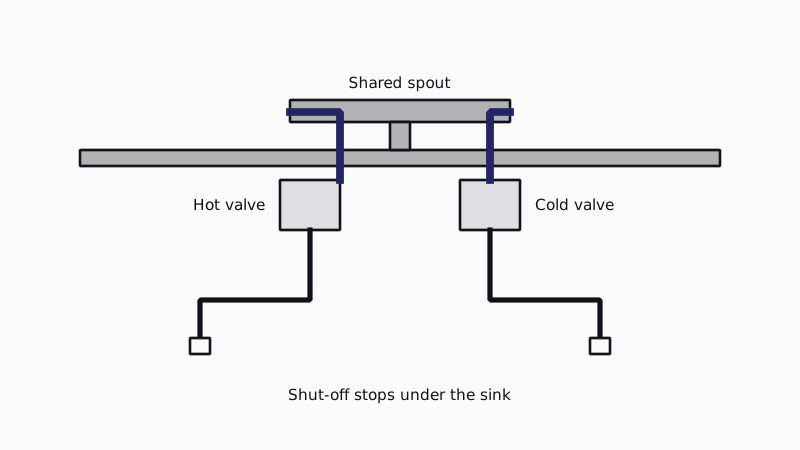
On a bathroom faucet with two handles, each handle works a valve of its own, hot on the left and cold on the right, which means a drip from the spout comes from one valve and not both. Test the drip for warmth, close that side's shut-off, and rebuild that valve. The kitchen side of the cabinet, with its sink machinery, falls under garbage disposal repair.
Which handle is behind the drip?
Warmth gives it away. Hold a fingertip in the drip: a warm drip points to the hot valve, a cool one to the cold. When unsure, close the hot shut-off valve beneath the basin and observe the spout. A drip that stops puts the fault on the hot side. A drip that carries on means you should close the cold instead, and then it should stop.
The spot where water shows tells you what has worn:
- From the spout: the seat or washer, or the cartridge seals, in that side's valve.
- Beneath the handle: the stem's O-ring or packing.
- From the base of the spout: the spout's own O-rings, or a cracked fitting.
- Below the basin: a supply line or connection, and not the faucet valves.
Sorting matters, because pulling both handles apart when only one side is faulty doubles the work. A drip that follows a handle only when the water is turned on is a stem fault. For other fixture types, the page on stopping a dripping faucet compares them.
When is a plumber the sensible option?
Bring one in when the shut-off valves fail, when parts break during the repair, when the leak is at a wall connection, or when the sink is a pedestal or vessel bowl with poor access. Do the same when you want a single visit to cover the faucet, the supply lines and the shut-offs together.
Ask for help through the quote page. We pass your request to a local plumbing business, and businesses that accept requests pay us a fee. That business makes the visit and names the price. Say that it is a two-handle faucet, which side leaks, and what the faucet looks like. If you suspect the drip is wasting water, can a leaky faucet raise your bill explains how to check. For the full list of plumbing help in the valley, see plumbing services in Temecula.
When does a new faucet beat a repair?
Choose a replacement if corrosion or a crack has damaged the body, the finish is peeling, the model's parts are discontinued, or repair would cost nearly as much as a replacement. Two or three drips after a rebuild usually point to a damaged seat, and a new faucet resets the whole set.
Fitting a new faucet is a modest job in an accessible vanity, with new supply lines and a few tools. It gets harder when the shut-off valves are stuck or the sink is cramped. Should a shut-off refuse to close, or leak as you turn it, stop work and phone a plumber, since forcing an old valve can turn a drip into a flood. The EPA reports that an average home wastes more than 9,300 gallons annually through leaks, and a steady faucet drip adds to that. A plumber can look at both options when you want to weigh a repair against a new fixture.
How do I rebuild a compression stem?
Replace the rubber washer at the stem's tip, along with the O-ring or packing around its shaft. Use a washer of identical size and shape, either flat or beveled. Clean the seat inside the faucet body; if it is rough, resurface it with a seat dresser or replace it using a seat wrench, then reassemble.
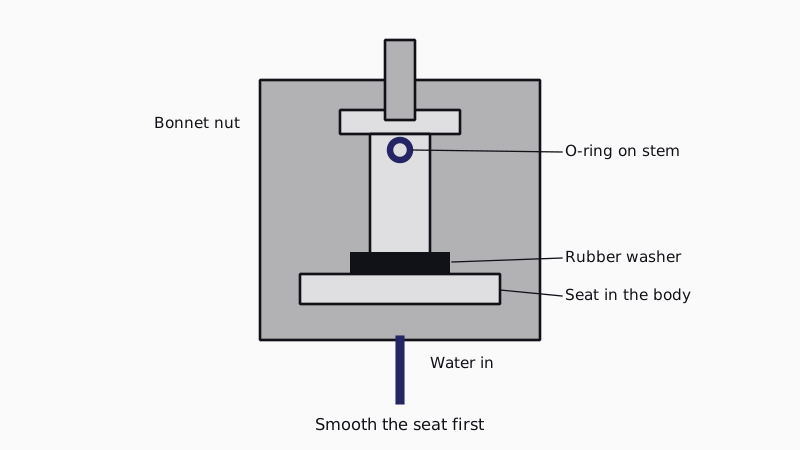
Inspect the washer screw as well. A corroded brass screw can snap and leave the washer loose. A seat that is deeply pitted will never seal against any washer. Then a new faucet may be cheaper than repairing the old one, since the body includes the seat. With a new washer, a greased O-ring and a clean seat, tighten the bonnet until snug but not hard, then open the supply slowly. Move the handle through its full range to confirm that it shuts completely without cranking.
How do I take a two-handle faucet apart?
Close that side's shut-off, run the tap until it drains and plug the sink. Lever the cap off the handle, remove the handle screw, lift the handle clear, and loosen the stem's retaining nut or bonnet with a wrench. Pull out the stem or cartridge, keeping the pieces in order.
A tidy sequence:
- Shut off the supply and open the tap to release pressure.
- Cover the drain and lay a towel in the basin.
- Remove the handle by lifting the cap and unscrewing the screw. Tight scale may call for a gentle twist, and a puller exists for stubborn handles.
- Wrap the nut with tape or a rag so the wrench does not mark the chrome, then unscrew it.
- Lift out the stem. On some faucets you reuse the handle to pull it.
- Photograph the parts as they come out.
Scale is the usual reason parts stick here. Rancho California Water District's own reports put average hardness around 230 to 240 mg/L, roughly 13 to 14 grains per gallon, in the 2020 to 2023 reports. That is very hard water, so soak crusty parts in vinegar for an hour before forcing them. Keep hammers away from every chrome part.
How is a cartridge or ceramic disc valve repaired?
Once the retaining clip or nut is off, pull the old cartridge straight up and out, noting its orientation, then seat an identical new one with the tabs aligned. Renew the O-rings and seals when the kit supplies them. Turn the supply on gradually and test both temperatures, because a backwards cartridge swaps hot and cold.
Ceramic disc cartridges last well but dislike grit. With the stem out, crack the supply open and hold a cup over the opening, so any debris is flushed away before the new cartridge goes in. If the faucet still leaks, inspect the seals at the base of the cartridge and look for a groove in the faucet body. A worn body cannot be cured by a cartridge. See fixing a leaky bathtub faucet for the tub and shower version of a two-handle valve, which is similar but sits behind the wall.
Which tools and parts will I need?
Gather an adjustable wrench, a screwdriver set, a small flat blade or pick for the decorative cap, a towel, a cup for screws, a replacement kit for your model, and plumber's grease. Compression faucets take washers and O-rings and sometimes a seat wrench. Cartridge and ceramic disc faucets take a matching cartridge.
First work out which kind you own. A handle that keeps turning, tightening against a stop, belongs to a compression valve, which squeezes a rubber washer onto a seat. A handle with a quarter or half turn belongs to a ceramic disc or cartridge valve. Look for the brand and model on the box, at the base of the spout, beneath the basin or on the maker's website. If no model name turns up, bring the worn part with you to the shop.
Common questions
Why does only the hot side drip?
Heat is tougher on rubber and seals, so hot valves wear out first. The hot side's washer or cartridge has likely hardened or scaled over. Fit a full valve kit on that side, and consider doing the cold side in the same sitting when both are the same age.
Do both handles need new parts at once?
No, repairing just the leaking side is allowed. Yet with an old faucet already taken apart, the other valve is probably worn too, and the kit is cheap. Doing both saves a second shut-off and reassembly, and a matched pair works the same way.
How do I deal with a handle that is stuck?
Scale or corrosion may be holding it. Wrap the base in a vinegar-soaked rag for an hour, then try again with a handle puller. A hair dryer's warmth can help slightly. Never pry against the sink, since porcelain cracks. If it still will not move, a plumber can free it.
How do I stop a leak where the handle meets the faucet?
The stem's packing or O-ring is the cause. Turn the water off, remove the handle, swap the O-ring or packing washer for a new one and smear on a thin coat of plumber's grease. Snug the packing nut slightly. If it still seeps, the stem itself may be worn, and replacing the whole stem is the next step.
How long does the job usually run?
A first-time rebuild usually runs about an hour, including the trip for parts. A second one goes much faster. Expect longer if the old parts are stuck. A plumber who arrives with the right kit can usually finish a two-handle faucet in one short visit.
For the wider picture, start with the plumber guide for Temecula.
Sources used
- EPA household leak figure (more than 9,300 gallons a year)
Updated