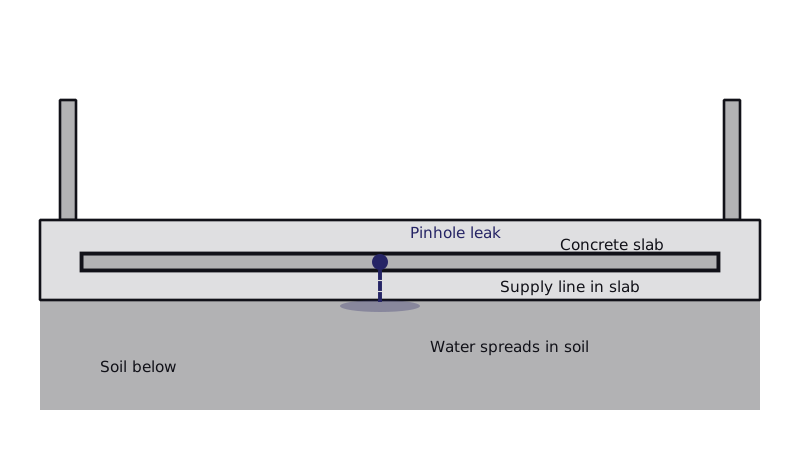
Water escaping from a pressurized line beneath or within a concrete foundation is called a slab leak. There are four ways to deal with it: open the slab above the leak, reroute the line around the slab, line the pipe, or repipe the house. The right choice turns on the number of leaks and the age of the pipe. Our main help for leaks in Temecula covers the wider picture.
How can you tell you have a slab leak?
A slab leak means water is getting out of a supply line that runs under or through the concrete floor of a house. Common signals are a water bill rising with no other explanation, the sound of running water while every tap is closed, flooring that feels warm, damp or starts to lift, and a meter still turning with all fixtures shut.
A drain leak is a different problem. Slab leaks involve a pressurized supply line, hot or cold. To test, make sure nothing is using water and check the meter. A turning dial or low-flow indicator points to a leak somewhere. Then shut the main and check again; a dial that stops tells you the fault sits on the home's side of the line. A plumber pinpoints the spot with listening equipment, and our guide to slab leak cost shows what that visit and the repair can run.
Many master-planned Temecula neighborhoods from the 1990s and 2000s sit on slabs, with Redhawk and Harveston as typical examples, yet not every home there has supply lines in the slab. Some tracts carry water lines through the attic or ceiling, so confirm before assuming. Rancho California tracts of the 1970s and 1980s may contain early copper. Heat coming through the floor suggests a leaking hot line, while hissing suggests a cold one.
Shut the main, keep electrical items off any wet floor, and photograph the damage so your insurer has a record. We have no verified insurance figures to offer, so ask your own insurer what the policy covers. For an active leak, see our emergency guide for a burst pipe.
Does a concrete roof slab or a leak outside the house count?
Water coming through a concrete roof slab is a roofing or waterproofing issue rather than a plumbing one, unless a drain line or supply pipe is involved. A break in the pipe running from the meter to the house is a service line leak, dealt with by a plumber and sometimes the utility. Who is responsible turns on which side of the meter the leak sits.
Soggy ground on a lawn or driveway can mean a leak in the yard line. Check the meter, and phone the water district if you cannot tell which side of the meter the leak is on. Rancho California Water District supplies many Temecula addresses, while parts of the city get water from Eastern Municipal Water District, so check your bill. When a plumber instead finds the leak in a drain line, the work differs and a drain camera may come into play.
When does a repipe beat fixing the leak?
Choose a repipe after several leaks, when the pipe is old or visibly corroded, when a plumber finds the wall and slab lines in poor shape, or when the fix would eat up a big share of the cost of new pipe. A lone leak in otherwise healthy pipe usually means a spot repair or a reroute. Repeated leaks signal an entire system that is wearing out.
The logic is straightforward. A repair deals with one weak point and leaves the others. Once pinholes show up in several places, more will follow, and every repair means opening floors again. A repipe swaps the supply lines for new pipe, commonly PEX or copper, and stops the cycle. Our guides on repiping a house in Temecula and on how a repipe is done explain the process, and repipe prices cover cost.
Pipe wear can be influenced by the chemistry of the water. Rancho California Water District's own reports put average hardness around 230 to 240 mg/L, roughly 13 to 14 grains per gallon, in the 2020 to 2023 reports. That is very hard water, and how it affects pipes depends on many conditions, so we cannot say it caused a given leak. Read the current report at ranchowater.com, and ask the plumber what shows inside a cut section of pipe.
How is a house on a slab repiped?
The common method leaves the old slab lines abandoned where they lie and brings new lines to each fixture through the attic or walls, in PEX or copper. The concrete stays intact, though drywall must be opened at certain points. The best route varies with the house layout, whether there is an attic or an upper story, and what the plumber can get to.
Request a drawing or walk-through showing the route of the new lines, the places where walls or ceilings get opened, and who patches and paints. Find out what material is proposed and the reason for it; our page on PEX versus copper lays out the trade-offs. Ask too if the water stays off all day, how many days the work runs and whether the quote includes the permit.
Expect disruption. A repipe means a day or more with no water, patched drywall, and belongings moved clear of the work. A single slab repair is briefer, though it may bring jackhammering and dust to one area. Neither job suits a homeowner.
Which repairs are available for a leak under the slab?
Three fixes target the spot or the section. The most direct approach is breaking the slab open over the leak and replacing that length of pipe. Rerouting leaves the leaking line abandoned and runs new pipe to the fixtures through walls or the attic. Pipe lining coats the inside of the pipe with resin, which spares the slab but does not suit every pipe or leak.
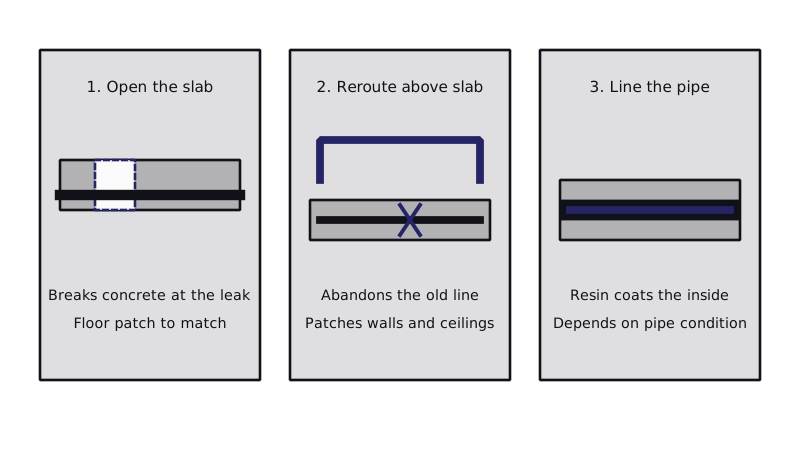
Each carries trade-offs. Digging through the floor is fast for a single leak and leaves a patch in the tile or flooring that may not match. Rerouting avoids more slab work and keeps the lines reachable later, but it puts new pipe in walls and ceilings along with the patching that follows. Lining disturbs the house least, yet relies on pipe condition, the number of fittings and the access points, so ask what the plumber would do if lining turned out to be unsuitable.
Find out from each plumber which of these methods they provide, since not every business does all three. A business with only one method will tend to push it. Have the choice and its reason put in writing, and ask what the surface repair includes, meaning whether flooring and baseboards are patched or only the concrete.
Permits matter here. Pipe replacement and rerouting often need one. In California, permit work requires a contractor license, as does any job worth $1,000 or more in labor and materials. In the City of Temecula, Building and Safety at 41000 Main Street answers permit questions on 951-694-6476. Riverside County covers addresses outside the city, and San Diego County handles Fallbrook or Rainbow.
Common questions
How many days does fixing a slab leak or repiping take?
A spot repair through the slab often takes a day or less, plus time for the flooring. A reroute usually takes a day or two. A full repipe typically takes several days, based on house size. Treat these as rough ranges, not promises; ask the plumber for a schedule that states how long the water stays off.
What should I ask a slab leak plumber first?
Raise these points: how the leak gets located, the repair options on offer, what the price includes, who handles the permit, what finishing the surface involves and the plan if further leaks show up. Have the price written down. You can also request a repipe estimate beside the repair quote, to compare the two.
Do I need to be at home during the work?
Yes, or send a trusted adult. Access to the whole house is needed by the plumber, the water goes off at intervals, and unexpected findings may call for decisions. Sort out pets, move furniture and clear the walls. If you cannot be there, settle the price and scope beforehand in writing.
Is it safe to ignore a small slab leak?
No. Even a slow leak can wash out soil, damage flooring, feed mold and waste water, and the EPA says an average household can lose more than 9,300 gallons annually to leaks. Small leaks tend to grow. Close the main if the leak is active, and get a plumber to find it and quote the options.
More services are listed on Temecula Pipe and Repair.
Updated