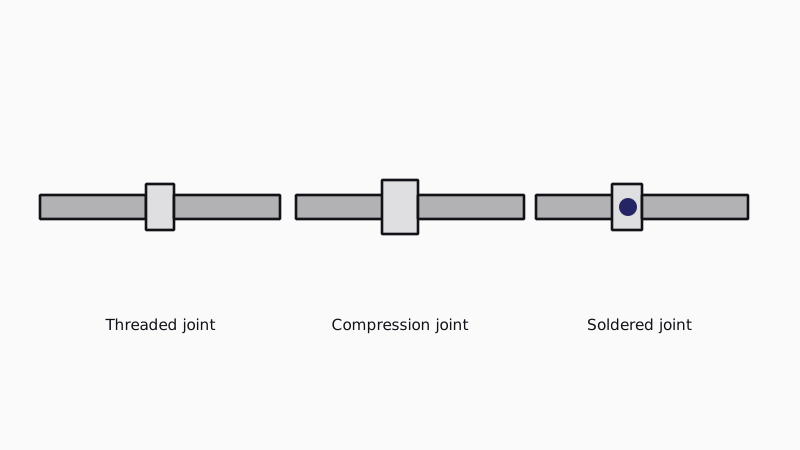
Often, yes: a joint can be repaired without cutting out the whole pipe, but only for certain joint types and only while the pipe itself is sound. Tightening or resealing works for threaded and compression joints, while a failed solder or glued joint usually calls for a new coupling. Stop the water first, then identify the joint. The leaks page covers the broader picture.
What type of joint is leaking?
Look closely before you touch anything. A threaded joint displays screw threads and sometimes a union nut; a compression joint has a brass nut and ring; soldered copper shows a bright silver band of metal; PVC and CPVC joints are glued, with a ridge of cement; PEX uses crimp rings, clamps or push-fit sleeves. Each is repaired differently, so identify the fitting first.
Then locate the true source. Water runs along a pipe and drips from the lowest point, so dry the area, then loop a paper towel around the joint and note where it turns dark. A wet joint with no corrosion or scale nearby often just needs resealing. Green crust on copper or a hairline crack in plastic signals a deeper failure.
Check the pressure as well. A joint that weeps only at night, when pressure rises, may hint that the pressure regulator is failing. Section 608.2 of the California Plumbing Code caps building water pressure at 80 psi, so any higher gauge reading needs attention. The page on the pressure regulator has more.
What about PVC, CPVC and PEX joints?
A glued PVC or CPVC joint that leaks cannot be tightened or sealed from outside in a reliable way. The usual repair is to cut the joint out and fit a repair coupling, or else remove the fitting and glue it again using primer and cement. A crimp ring on PEX can be re-crimped or replaced, and a push-fit sleeve can be replaced.
Details on plastic are on the page about stopping a leak from plastic pipe and the page about PVC glued joints. Never use a flame near plastic pipe, and do not glue wet pipe.
PEX should not sit in direct sunlight for long, and a leak at a fitting in the garage or attic is a prompt to check the lines for sun damage.
Do clamps, tape and sealants work?
As a temporary measure, yes. A repair clamp, self-fusing silicone tape or epoxy putty can stop a drip until a proper repair. They are not permanent, and on a pressurized supply line they can fail without warning. Use them to buy time, not to close the job.
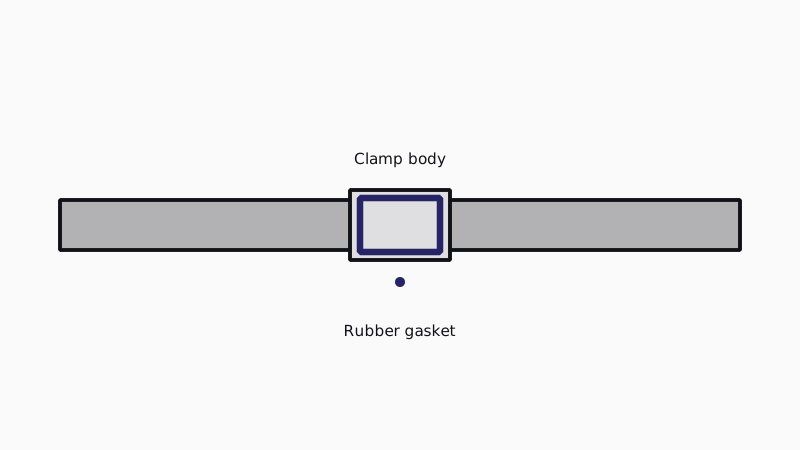
Sealant products have their place. A leak-sealing product can slow a weep but does not fix a failed fitting, and there are limits to what a plumber will accept inside a wall. The guide to pipe leak sealants explains what to expect.
Gas lines are not a DIY matter, and no tape or sealant is acceptable on a gas joint. When gas can be smelled, walk out of the building first, then phone SoCalGas on 1-800-427-2200 from outdoors, or dial 911.
Can you repair a soldered copper joint without cutting it out?
Sometimes. A pinhole in a solder joint can be reheated and re-soldered, but only with the pipe fully drained and bone dry, since water inside stops the copper from getting hot enough. Leftover moisture sinks most DIY attempts. The common modern fix is a push-to-connect or press coupling, cut in over the bad section.
Torch soldering near framing is a fire risk, and in an attic or wall cavity it calls for a heat shield and a fire extinguisher within reach. For a joint near a wall, ceiling or anything flammable, a plumber or a mechanical coupling is the safer choice.
If copper around the joint is green, pitted or thin, the pipe itself is failing. Hard water in the area, with Rancho Water's reports putting average hardness around 230 to 240 mg/L in 2020 to 2023, can add scale and, in some houses, pitting. Read leaking copper water pipe repair for pinholes.
When should a plumber be called, and what does it cost?
Call one if the leak is in a wall or ceiling, on a main line or a gas line, if the pipe is corroded, if the shutoff refuses to close, or if your own repairs keep failing. The plumber can replace the section correctly, test it and tell you whether more pipe is at risk. A California contractor license is required for jobs reaching $1,000 and for any work needing a permit.
The work is done by a local plumbing business, and this site forwards your request to one; that business pays us a fee. No prices appear here, as they hinge on access and materials. Describe the joint, with photos, on the quote page. Other services are on the home page.
Per the EPA, household leaks lose more than 9,300 gallons of water a year, so even a slow drip deserves a fix.
How do I stop a threaded or compression joint from leaking?
Shut off the water, drain the line, and give the nut a quarter turn with a wrench while holding the other fitting still. If it keeps dripping, disassemble it, clean the threads, apply fresh thread tape or pipe dope to threaded parts, and swap the ring or gasket on a compression fitting. Put it back together gently and test slowly.
Never over-tighten. Brass and plastic can split, and replacing a split fitting involves more work than resealing a weeping one. A rusted threaded steel pipe is a different story: with a thin pipe wall, forcing the joint can snap it.
Old compression ferrules can seat badly once moved. Replace them; a new ferrule is cheap. On a shutoff valve under a sink, a gentle snug of the packing nut under the handle will often end a drip at the stem.
Common questions
Can plumber's tape fix a leaking joint?
Only for threaded joints, where tape on the male threads aids the seal when you reassemble. It is useless on soldered, glued or compression joints. Wrap clockwise as you face the end of the pipe, and avoid over-tightening, which can crack fittings.
Is epoxy putty a lasting repair?
Usually not. A small weep on a clean, dry pipe can be stopped by it, and some people leave it in place for years, but a pressurized supply line can fail without warning. Treat it as a stopgap and replace the section or the fitting when you can.
What stops a leak immediately?
Shut the nearest shutoff valve or the main, then open the lowest faucet to empty the line and set a bucket under the joint. Dry the area and photograph it. With water near electrical equipment, keep clear and call for help.
Will a leaking joint raise my water bill?
Yes, even if the drip is slow. The EPA's figure of over 9,300 gallons lost per household yearly is built on small, constant leaks. Read the meter while all fixtures are off: movement means something is leaking, and the joint is only one possible source.
Updated