Fixing a leaking copper pipe starts with closing the water, draining the line and drying the pipe. After that you either clamp the leak for the time being or cut out the damaged section and put in a push-fit, crimped or soldered coupling. The choice rests on the leak's location and the look of the pipe. Wider leak topics are grouped under leaks and burst pipes.
Which type of copper pipe leak do you have?
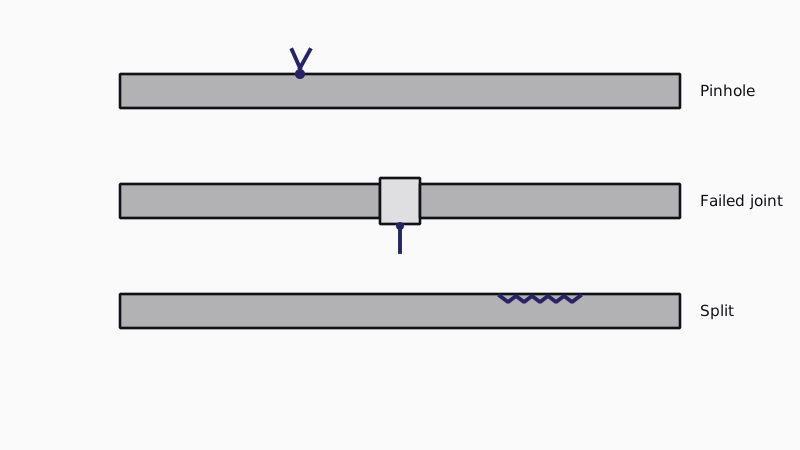
Look before you fix. A pinhole is a tiny pit that sprays or weeps through the pipe wall. A joint leak appears at a fitting, usually where solder has failed. A split, often caused by freezing or an impact, is a crack along the pipe. Which one you have determines if a patch will hold or the section has to be replaced.
Clues to read:
- Green or white crust and staining around a spot means a long, slow seep, usually at a joint or a pinhole.
- A thin jet of water, sometimes a fine mist, is a pinhole under pressure.
- A bulge, or a long slit through the pipe wall, is a freeze or impact split.
- Wet insulation, a ceiling stain or a meter reading that moves with taps off all signal a hidden leak.
One pinhole in an otherwise sound pipe is a repair. Several pinholes in different places suggest the pipe is wearing out, and patching then becomes a stopgap. To judge which applies, see when a house needs repiping.
What can you do the moment a copper pipe leaks?
Close the nearest isolation valve, or the home's main, then let the line empty through a low tap while a high tap lets air in. When the pipe is dry, fit a repair clamp over the spot or wrap it in self-fusing tape. That can hold for days or longer, yet it only bridges the gap to the real repair.
A quick order of actions:
- Stop the water at the nearest valve, or at the main if that valve is missing.
- Turn the water heater off when hot lines are involved and the tank could drain.
- Open taps to release pressure and drain the pipe.
- Wipe the pipe dry with a rag, as putty or a clamp cannot grip a wet surface.
- Position a rubber-backed clamp centered on the leak and tighten it evenly.
- Bring the water back slowly and watch for seepage over a few minutes.
A leak within a wall means turning the water off and calling a plumber. Never cut drywall close to live wiring before the circuit is off. Look at the ceiling below too, as water travels. Pinholes and joint failures behind finished walls are quiet and costly if ignored; the EPA says leaks waste more than 9,300 gallons per year in a typical household.
How is a copper pinhole repaired?
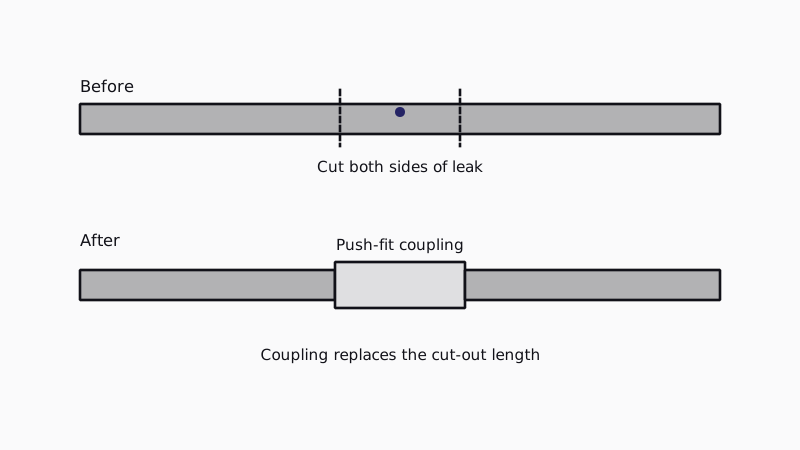
In the short term, a clamp can cover a pinhole in sound copper. For a lasting fix, cut away a few inches around the hole and join in fresh pipe with couplings. Older pipe often has more pinholes close by, so inspect both sides of the spot.
Methods, from simplest to most skilled:
| Method | Notes |
|---|---|
| Repair clamp | Quick, temporary, needs a dry smooth pipe |
| Push-fit coupling | Needs a clean, square cut, no solder, no flame |
| Crimp coupling | Needs a special crimp tool, similar to PEX work |
| Soldered coupling | Permanent, needs skill, dry pipe and a flame |
Epoxy putty can seal a small leak for a time, but it is the weakest of these and does not suit pipes under constant pressure. Detailed steps for this particular fault are in the guide to mending a pinhole leak in a copper line.
Is soldering copper pipe a DIY job?
It can be, but it is easy to get wrong, and a hidden mistake turns into a leak behind a wall. Soldering needs a bone-dry pipe with no water or steam left, a clean, fluxed joint, lead-free solder, and a torch used away from wood, insulation and wiring. Many homeowners are better with push-fit couplings.
Safety points:
- Keep a fire extinguisher or a bucket close, and shield nearby wood and insulation.
- Water trapped in the pipe will block the heat and spoil the joint, so drain thoroughly. If a valve keeps a trickle going and the pipe will not dry, stop and call a plumber, who has tools to plug or freeze the line.
- Use solder and flux made for potable water, which means lead-free.
- Keep any torch away from gas piping, and never work on gas lines yourself. If you smell gas, get everyone out and call SoCalGas at 1-800-427-2200 from outdoors.
Push-fit couplings call for a clean, burr-free, square pipe end and the right insertion depth, marked on the fitting. They suit accessible spots, not hidden ones. Whether a fitting should sit behind a wall is a question for a plumber.
What makes copper pipe leak to begin with?
Age, water chemistry, high pressure and flow, poor joints and freezing are the main causes. Pinholes form as the pipe wall is slowly eaten away from inside. Local water is very hard: Rancho California Water District's own reports put average hardness around 230 to 240 mg/L, roughly 13 to 14 grains per gallon, in the 2020 to 2023 reports. No single cause is proven for any house.
Pressure over 80 psi, the limit in the California Plumbing Code, is another driver, as it wears pipe and fixtures faster. A regulator is the usual cure, and the check is explained in adjusting a pressure regulator. Hot lines tend to fail earlier than cold ones. Freezing is uncommon in the city but real in higher, rural stretches of the valley, Aguanga for one. Homes from the 1980s and 1990s may carry copper of that period, so the house's age is a useful clue.
Which copper leaks belong to a plumber?
Call one when the leak is hidden in a wall, ceiling or slab, the pipe is corroded in several places, the isolation valve will not shut, the pipe is part of a gas or heating system, or cutting and joining is beyond your comfort. Replacing a pipe run larger than a small repair can need a permit too.
Permit offices vary by address. Inside the city limits the City of Temecula runs Building and Safety, while unincorporated areas like Wine Country and French Valley come under Riverside County. The plumber normally files the permit. If the leak has already damaged drywall or flooring, ask the plumber to note it for your insurer, and keep photographs.
To begin, fill in the quote page form. It goes from us to a local plumbing business that pays us a referral fee, and that business then visits and gives you a price. For a leak in the floor itself, see slab leak repair or repipe.
Common questions
Is it safe to leave a leaking copper pipe until the repair?
For a short while, sometimes, with a clamp fitted and the area watched. Pinholes can grow and splits can give way suddenly. If the leak is by electrical equipment, overhead or inside a wall, shut the main right away. Water damage grows far faster than the pipe repair costs.
Does plumber's tape seal a leaking copper pipe?
No. Thread tape seals threaded joints and does nothing for a hole in smooth pipe. Holes in the pipe wall call for a clamp, a sleeve or a cut-and-couple repair. Self-fusing silicone tape may hold a small leak briefly, but treat it as temporary and plan a proper repair.
Why does my copper pipe leak at the joint?
Thin or poorly made solder may be the cause, or flux residue may have corroded it, or movement and water hammer may have worked it loose. Reheating and resoldering a seeping joint works only on a dry pipe. Otherwise, remove the fitting and fit a new one.
How much time does a copper pipe repair take?
Swapping a simple coupling in an accessible spot is a short job. Longer jobs involve opening walls, draining a hot water loop, soldering several joints and patching afterward. An estimate of the time is possible once the plumber has seen the pipe. Expect the water to be off during part of the visit.
Should one leak lead to replacing all the copper?
Not necessarily. When the rest of the system is sound, one leak is just a repair. Repeat leaks, green stains at many joints or pinholes in different rooms suggest the pipe is wearing out, and a partial or full repipe is then worth pricing. Have the plumber show you the cut-out section.
This guide is one of many on plumber in Temecula.
Sources used
- City of Temecula, building and permits
- EPA household leak figure (more than 9,300 gallons a year)
Updated