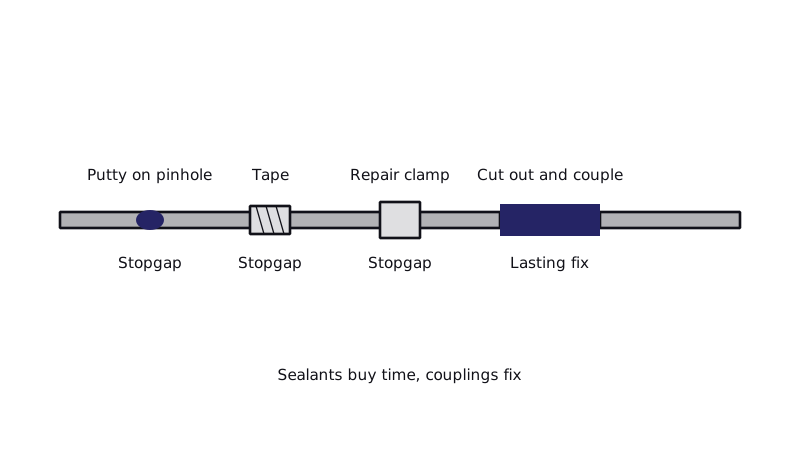
Treat any sealant as a short-term patch. Epoxy putty and repair tape can hold a pinhole or a weeping joint, a rubber-lined clamp holds a split, and in-pipe liquid products are the least reliable choice on a drinking water line. First of all, shut off the supply and wipe the pipe dry. Should the leak come back, plan a cut-out repair. Wider leak help is at the page on plumbing leaks.
Which sealant suits which leak?
Match the product to the leak. Epoxy putty is right for a tiny pinhole in pipe that is dry. Self-fusing silicone tape wraps a seep or a small split and copes with movement. A rubber-lined clamp covers a longer split or a corroded patch. Compression or push-fit couplings stand in for a cut-out section. Nothing reliable seals a leak at a fitting under pressure.
A quick guide:
| Leak | Reasonable stopgap | Limits |
|---|---|---|
| Pinhole in copper | Epoxy putty, or a small clamp | Pinholes tend to come in groups, so more will follow |
| Weeping threaded joint | Fresh thread sealant or tape after taking it apart | A fitting that seeps under pressure with no tape is cracked, not just loose |
| Small split in plastic pipe | Self-fusing tape, repair clamp | Plastic flexes and cracks further, so cut and couple soon |
| Longer split in a metal pipe | Rubber-lined repair clamp | Clamp over round, clean pipe only |
| Dripping glued joint on PVC or CPVC | Cut out and re-cement or use a coupling | Glue over a wet joint does not hold |
| Leak behind a wall or under a slab | None within your reach | Needs a plumber to trace and open |
For a split plastic pipe in particular, the page on stopping a plastic pipe leak gives the cut-and-couple steps.
How do I apply epoxy putty or repair tape correctly?
Start by closing the supply and draining the line. Towel the pipe dry and scuff the metal with sandpaper. Then either press mixed epoxy over the leak or wrap tape around it, stretching each turn and overlapping the previous one by half. Wait out the cure time printed on the packet before restoring water. Nothing bonds to a damp pipe.
Failures nearly always come down to preparation:
- A wet or oily pipe. Epoxy needs a dry, scuffed surface. Wipe with a rag and a little rubbing alcohol if the packet allows it.
- Skipping the cure time. Putty that looks hard can still be soft inside.
- Hot water lines. Check the temperature rating, because some tapes and putties are for cold water only.
- Pressure. A patch that holds at a trickle may fail at full pressure. Without a way to isolate the line, no patch will be dependable.
Choose a product that says it is suitable for drinking water. A label reading NSF/ANSI 61 is the standard for contact with potable water, so check the packet if the line feeds a tap. Products meant for radiators, roofs or boats may not be.
Do liquid sealants poured into the pipes work?
Some products are added to a system and claim to seal leaks from the inside. They suit closed heating loops more than drinking water pipes, and they may clog valves, aerators, filters and the heater. On a household potable line they are a poor bet, and a plumber opening your pipes later will not be glad to find one.
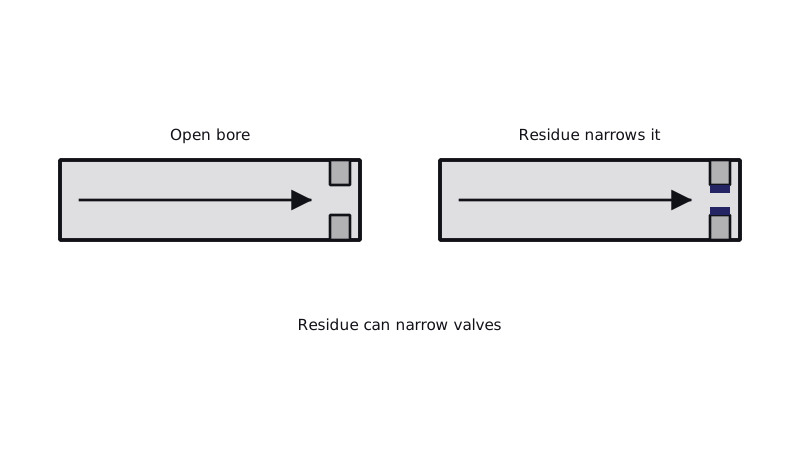
Water supply lines need to stay clear and clean, and a sealant that sets on meeting air at a leak can also set in places you do not want it. Skip any product without a clear drinking water rating. A stubborn leak calls for repairing or replacing the pipe. A short pinhole repair may be a section swap, and recurring leaks signal that the pipe is wearing out.
Why is the pipe leaking at all?
Leaks have causes, and patching ignores them. In copper, pinholes can follow corrosion from water chemistry or high velocity. Rancho California Water District's 2020 to 2023 reports put average hardness around 230 to 240 mg/L, which is very hard, and scale can foster pits over time. Joints loosen from vibration, pressure spikes or movement. Plastic cracks from freezing or sun.
Check three things after any leak:
- Pressure. The plumbing code's limit is 80 psi, and a house above that stresses every joint. Measure it with a gauge threaded onto an outdoor hose bib, and the pressure regulator page explains the fix.
- Water hammer. Banging pipes shock joints and lead to leaks over time.
- Age and material. Several leaks within a year in the same pipe is a pattern. Early Rancho California homes may have copper that is thinning, and some homes from that era have polybutylene. If the pattern fits, a repipe discussion belongs on the table, covered on the repiping page.
For copper pinholes the pinhole repair guide goes deeper, and for a joint that weeps there is a page on fixing a leaking joint without replacing it.
When should I stop patching and call a plumber?
Pick up the phone when the leak sits in a wall, ceiling or slab, when a stretch of pipe is corroded, when a patch has failed twice, when the line cannot be shut off, or when damp patches keep coming back. According to the EPA, a typical household can lose more than 9,300 gallons a year to leaks.
A plumber's repair normally removes the damaged section and joins in new pipe using a coupling, or soldered or crimped fittings. Some jobs need permits, particularly water heater, main line and repipe work, and contractor licensing rules apply: California requires a contractor license for permitted jobs and, as a rule, for work over $1,000 in labor and materials. Never put sealant on a gas pipe. If you smell gas, leave the building, call SoCalGas at 1-800-427-2200 from outside, and dial 911 if anyone is in danger.
To request a repair quote, the quote page asks for a short description covering the pipe type, the leak location and any fixes you have attempted.
Common questions
What is the lifespan of a pipe leak sealant?
It depends on the product, the surface prep and the pressure. Tape and putty can last days to years on a small, well-prepared leak, but treat them as temporary. A clamp lasts longer on straight pipe. Any patch on a pipe that is corroding fails when the next hole opens.
Does plumber's epoxy work on damp pipe?
Some epoxies are made to cure on damp surfaces, but most bond best to a dry, scuffed pipe, and the packet will say which yours is. If water keeps flowing, shut the line off and drain it first. A patch pressed over a live leak often fails when pressure returns.
Is leak sealant safe for drinking water pipes?
Only if the label says it is suitable for potable water, for example by listing NSF/ANSI 61. Many sealants are made for roofs, boats or heating loops. If the packet does not clearly say drinking water is fine, assume it is not suitable and choose another product.
Will sealant fix a leak in a copper pipe?
Briefly. A pinhole patch can stop a drip for a while, but copper that has one pinhole often has others starting nearby. Replace the damaged section if you can, and think about whether the whole run of pipe is wearing out, since that decides how long any repair lasts.
Does fixing a leaking pipe need a permit?
Replacing a short section with the same material usually needs no permit, whereas repiping, swapping a water heater or main line work usually does. If you are unsure which side your job falls on, the building department covering your address can tell you.
This guide is one of many on Temecula Pipe and Repair.
Updated