
The honest reason to repipe is a pattern: the same system keeps failing in new places. One leak is a repair. Three in a year, in different spots, usually means the whole run is worn. This page lists the reasons that justify it. If you want the full process and options, go to the repiping overview.
What is the main reason people repipe a house?
Repeated leaks. When pinholes keep showing up in different sections of the same material, patching each one adds up to more than replacing the lines would, and every leak risks wall and floor damage. A plumber who sees several repairs, patches or clamps along old pipe will often recommend replacement for that reason.
A second driver is a material with a poor track record, such as galvanized steel rusted closed from the inside, or polybutylene found in some homes of a certain era. Check what the walls really contain rather than assuming from age.
Third is simple access. If walls are open for a remodel or a slab repair, replacing lines at the same time can cost less than opening them again later. That timing logic is a legitimate reason all by itself.
When should you not repipe?
When a single leak has one clear cause and the remaining pipe is sound. A burst from a one-off freeze, a failed fitting or a damaged section can be fixed with a section swap. Repiping also makes little sense when the real issue is low street pressure or a bad regulator, and when a house is about to be demolished.
Age by itself is no reason. Copper can last for many decades in good water conditions, and plastic piping has its own limits. Ask what specific evidence points to failure: photos of corroded pipe, pressure readings, a camera or moisture survey, a count of earlier repairs.
Get a second opinion if one business recommends a full repipe and another says a repair will do. Differences in advice are normal; ask both to explain what they saw.
Should discolored water push me toward repiping?
Sometimes, when the discoloration comes from the pipes and not the street. Rusty water from the hot side only often points to the heater tank, while discolored water at every tap after a night of no use can mean corroding steel lines. Run the tap for a minute and watch whether it clears. A plumber can tell which it is.
Cloudy or metallic-tasting water is a reason to test, not to guess. Local supply quality is reported by your district in its annual Consumer Confidence Report, and Rancho Water publishes theirs on its site. If your water tests fine at the meter but poor at the tap, the home plumbing is the suspect.
Houses plumbed before the mid 1980s may contain lead solder on copper joints, which federal rules banned for drinking water systems from 1986. If you suspect it, have a lab test your tap water, and your water district can say how to arrange one.
Does low water pressure mean you should repipe?
Sometimes, but not as a first step. Weak flow can come from the street supply, a clogged aerator or showerhead, a partly closed valve or a regulator that is failing. Pipes narrowed by scale or rust do it as well, and then replacement is the real cure. Measure pressure with a gauge before you commit to a repipe.
Steel lines clog from the inside over decades, and Temecula water is hard: Rancho Water's reports put average hardness around 230 to 240 mg/L in the 2020 to 2023 editions. Scale does build up in copper and fittings, but it is a bigger flow problem in old galvanized pipe, which can narrow to a fraction of its original bore.
If the weak flow is at one faucet, look at that fixture first. For a house-wide problem, read about low pressure causes.
What does a repipe cost, and how long does it last?
The price turns on house size, fixture count, material, access and patching, so there is no honest single figure here. The repipe cost page explains what goes into a quote. Life expectancy is covered on the page about how often to repipe.
Material choice affects both. PEX and copper each have fans, and the right one depends on the walls and the water. A local plumbing business does the repiping and prepares the quote; this site passes the request along, and the business pays us a fee. The main page has more.
How do slab leaks and repeated pinholes point to a repipe?
A slab leak under a concrete floor is costly to reach, and when lines in the slab are corroding, more leaks tend to follow. A common response is to route new lines up in the attic or within the walls and leave the slab runs abandoned. The guide to slab leaks and repiping weighs the two.
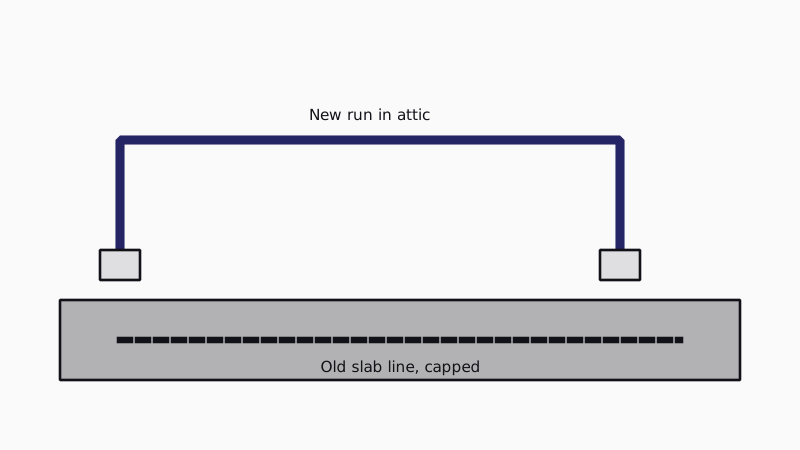
Typical signs include a floor that is warm in one spot, running-water noise when every fixture is off, a meter that never stops turning, warm patches in a bathroom, or a sudden bill increase. The EPA puts the yearly loss for an average household at over 9,300 gallons, and a slab can hide that loss for a long time.
Master-planned neighborhoods built in the late 1990s and 2000s, with slab foundations, may start to show these problems as their original lines age. That is a matter of years of service, not a prediction for any specific street.
Common questions
What is the way to tell if my pipes are galvanized?
Scratch the pipe lightly: galvanized steel looks gray, attracts a magnet, and is often threaded at joints. Copper shows a reddish brown, while plastic is easy to recognize. Galvanized was common in older houses, and the galvanized pipe replacement guide explains what to do with it.
Will a repipe raise my home's value?
It may ease a sale, since buyers and inspectors fret over old or failing pipes, and a documented replacement removes that worry. Whether it raises price by more than it cost depends on the market. Keep the permit, invoices and pressure test records, since they are what a buyer will ask to see.
Does a repipe require tearing out walls?
Often some openings are needed, but a plumber can fish many lines through attics, closets and existing access points to keep the holes small. Expect patches near fixtures and at corners. Ask where the openings will be and who repairs and repaints them, since that can be a separate trade with its own cost.
Is a permit required to repipe?
Usually. Repiping counts as plumbing work that normally needs a permit, and any job needing one must be done by a contractor who holds a California license. In Temecula the permit office is City of Temecula Building and Safety; unincorporated areas use Riverside County. Confirm at the parcel level before work starts.
Updated