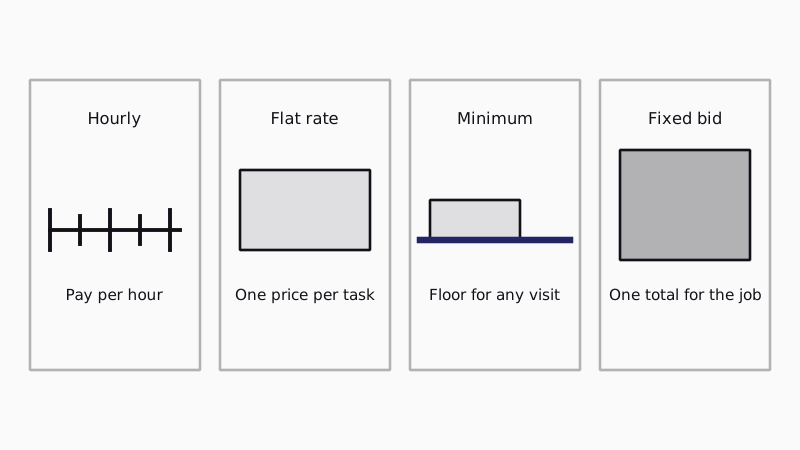
Labor is charged in one of four ways: by the hour, by the task at a flat rate, by a minimum visit charge, or by a fixed price for a whole job. No table of dollar figures is printed here, since a reliable local source was out of our reach and an invented list would mislead you. What follows is how the charges are built. The home page shows what can be arranged.
Why is there no standard plumbing labor price list?
Each plumbing business sets its own rates, based on its costs, the work and the hour. Any list we published would be an invention, and the real number is the one on a written quote for your job. What is standard is the structure: a call-out or minimum charge, labor, materials, and extras such as permits and disposal.
Several things move the rate between businesses: how much equipment the plumber carries, whether the work is routine or specialized, whether the visit is during office hours, and how far the plumber travels. That is why two honest quotes can come in at different numbers for one job. The useful skill is not finding the cheapest number, but comparing like with like, and that is what the sections below help with.
How do plumbers charge for labor?
Four models cover almost everything. Hourly billing counts time on the job, and sometimes travel. Flat-rate billing attaches a price to a named task, for instance swapping a toilet fill valve, however long it takes. A minimum charge sets a floor for any visit. A fixed bid gives a bigger job, such as a repipe, a single figure.
What each means for you:
| Model | Good for | Watch for |
|---|---|---|
| Hourly | Unknown faults, diagnostics | Is travel time billed, and in what increments |
| Flat rate per task | Common repairs and replacements | Exactly what the task covers and leaves out |
| Minimum or call-out charge | Short visits | Whether it counts toward the final bill |
| Fixed bid | Large, defined jobs | Change orders if the job turns out different |
Find out which model is in use before the plumber starts. Hourly work is fair when nobody knows the cause, since the plumber cannot promise a time. A flat rate is easier to compare, but only if two businesses are quoting the same scope.
What should a written plumbing quote contain?
A good quote lists the work, the labor, the materials, any permit, haul-away and tax or fees, with a total, plus a note about what might alter it. If the quote is a single number with no detail, ask for a breakdown so you can compare it with another.
Lines to look for:
- Scope: exactly what will be done and where.
- Labor: hours and rate, or the flat price.
- Materials: the parts by name, for example a fill valve, a shut-off valve or a water heater with its size and type.
- Permit and inspection, if the work needs one.
- Disposal of old fixtures and clean-up.
- After-hours or emergency premium, if it applies.
- Terms: payment schedule, warranty on the work, and the plan if a hidden problem appears.
California sets consumer rules for home improvement contracts. The state's contractor regulator, the Contractors State License Board of California, says any work requiring a permit generally needs a contractor license, as does work reaching $1,000 or more in labor and materials. It adds that a written contract is required above $500, and that deposits are generally limited to the lesser of $1,000 or 10 percent of the price. Check the current rules on its site before signing.
How does labor differ between kitchen and bathroom jobs?
Fixture swaps are the simplest to price: a faucet or toilet in a kitchen or bathroom with working shut-off valves is a defined task. Labor goes up if the valves are stuck, the pipe is old, the cabinet is cramped, or the work means opening a wall. Those conditions are why an on-site look can change a phone estimate.
Typical conditions that add labor in Temecula homes:
- Stuck or leaking angle stops under sinks, which then need replacing first.
- Older galvanized or early copper supply lines that cannot take disturbance.
- Slab-on-grade houses where a leak means breaking floors, not opening a ceiling.
- Access: attic, crawl space, tight closets.
- Hard water scale that seizes fittings and valves. Rancho California Water District's own reports put average hardness around 230 to 240 mg/L, roughly 13 to 14 grains per gallon, in the 2020 to 2023 reports, so scaled fittings are common.
None of these is a sign of a dishonest quote. They are real reasons for labor to vary, and a plumber should be able to say which applies to you.
Do permits change labor charges?
Yes, when the job needs one, because the permit, the inspection and the waiting add time and fees. Replacing a water heater or changing supply pipework generally needs a permit, which inside Temecula city limits comes from the Building and Safety office. Beyond the city, Riverside County is the issuer, while San Diego County covers De Luz, Fallbrook and Rainbow.
The plumber normally handles the permit and passes the fee on. See whether it appears in the quote. Permitted work also generally calls for a California contractor license. A suggestion to skip the permit to cut cost is a red flag, because an unpermitted job can cause trouble with insurance and a sale later.
How should I compare two quotes?
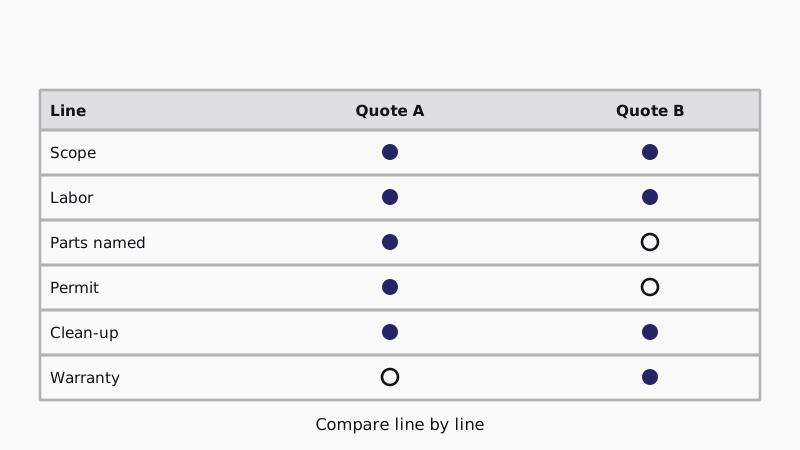
Set them side by side on identical items: scope, labor, materials, permit, clean-up, warranty. A lower total with a smaller scope is not cheaper. Ask each business what is excluded. Favor the quote that names parts and states the warranty, even if the number is slightly higher.
Questions that settle most comparisons:
- Is the price fixed, or an estimate that can rise?
- What does the call-out fee cover, and is it credited?
- Who obtains the permit, and does the price include it?
- What warranty is there on labor, in writing?
- How is the after-hours rate calculated?
For the broader picture of what drives plumber bills here, read plumber cost in Temecula. On hourly rates in particular, read what an hour of plumber time should cost and, for businesses, commercial plumber hourly cost.
Common questions
Should I expect a call-out fee?
Yes, many plumbing businesses charge one or a minimum visit charge to cover travel and the first stretch of time. Ask what it includes and whether it comes off the bill if you proceed. A clear answer is a good sign. A call-out fee that is not disclosed until the plumber is at the door is worth a question.
Are after-hours plumbing rates higher?
Many businesses charge a premium for evenings, weekends and holidays. It varies, so ask for the rate before agreeing and see it on the written quote. If the problem is a leak you can stop by closing a valve, it may be worth waiting for normal hours, but never delay for a gas smell or active flood.
Can I get a price over the phone?
You can get a rough figure for simple, well-defined jobs, but a firm price for a repair usually needs a look. Describe the problem, the fixture, its age and access. A phone number is only an estimate, so have the final price written down before work starts.
Why do two plumbers quote different labor for the same job?
Scope, equipment, experience, overheads and the hour can all differ. One quote may include a permit and clean-up where the other leaves them out. Compare line by line before deciding. A difference that cannot be explained by scope is worth asking about directly.
How does getting a quote here work?
Describe the job through the quote page. We pass your request to a local plumbing business. Those businesses pay us a fee for requests, and whichever one contacts you sets and explains the price. Before you commit to anything, you will have the quote in writing.
Sources used
Updated