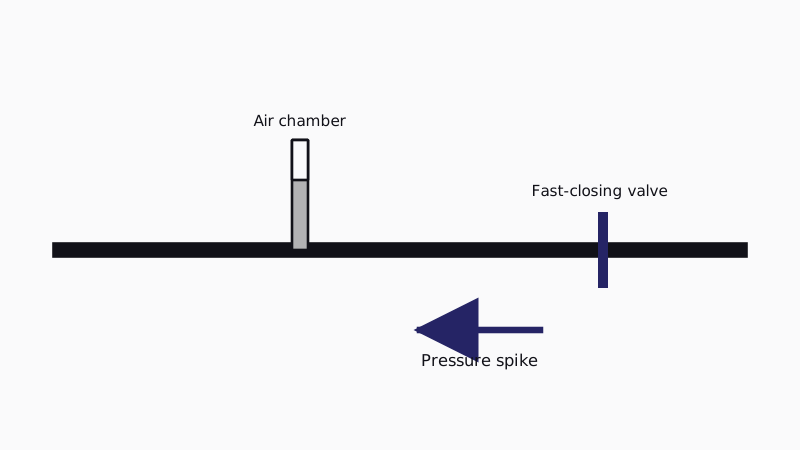
Water hammer is the name for a bang, thud or rattle that follows a tap closing. Flowing water halts abruptly, and the resulting pressure wave rebounds through the pipework. Dishwashers, washing machines and toilet fill valves often set it off, and so can a kitchen faucet with a quick-close lever. Browse the rest of our plumbing help or send a request if the banging has you worried.
What makes pipes knock as a tap shuts off?
It is a pressure surge. Moving water has momentum, and when a valve snaps shut the water has nowhere to go, so it hits the closed valve and throws a shock back down the line. Wikipedia describes the sound as a loud bang, a series of bangs as the wave bounces through the pipes, or a shudder.
The noise usually comes from near the fixture that just closed, but it travels, so a bang in the bathroom wall might come from the kitchen dishwasher. Note which appliance or tap is running when it happens. Washers and dishwashers use solenoid valves that close within a split second, so the thump comes as a fill cycle ends, not as it starts. Repeated surges stress fittings over time.
If the sound is a rattle or a tick rather than a bang, and it happens when hot water runs, it may be loose pipes expanding against straps. That one is annoying but harmless, and it is a different problem from hammer.
Can water hammer do damage?
Mild hammer is a nuisance. Strong or frequent hammer is worth fixing, since repeated shocks can loosen joints, wear washing machine valves and eventually cause a leak at a fitting. High supply pressure is a common contributor, which links hammer to the pressure regulator at your main, covered in our page on weak and excessive pressure.
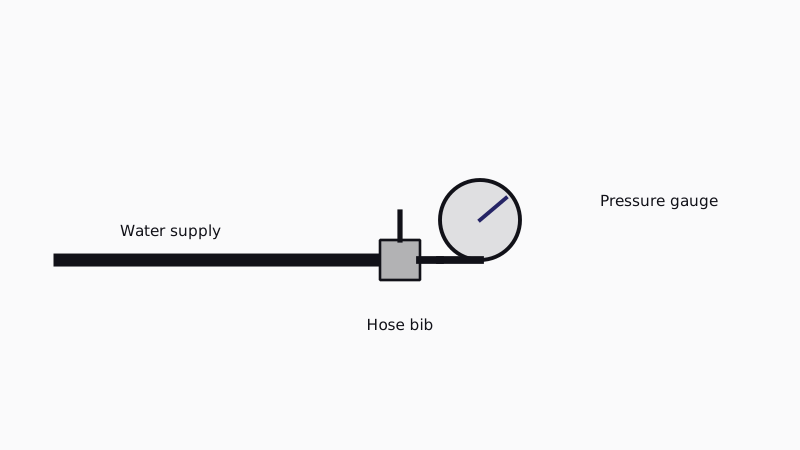
Under the California Plumbing Code, household pressure may not exceed 80 psi. InspectApedia notes that high supply pressure can make the relief valve on a water heater leak, so a house with both hammer and a dripping relief valve probably has a pressure problem. A gauge on an outdoor hose bib gives the reading, taken with nothing else running in the house.
In older homes, original shutoff valves and fittings have had decades of cycles, so the effect of surges adds up. The cure costs less than a repair after a leak, so treat repeated banging as a maintenance item.
What can I check myself first?
Start with pressure. Attach a low-cost gauge to a hose bib, and note the reading with every fixture turned off. A figure near or over 80 psi calls for a plumber and a regulator check. If pressure is normal, look at the fixture that triggers the bang, and check whether loose pipes in the attic, garage or crawlspace are knocking when they move.
A simple checklist:
- Note which fixture makes the sound, and whether it happens on closing or on opening.
- Take the pressure reading from a hose bib.
- Check that exposed pipes are strapped and cushioned where they pass through framing.
- Look near washers and dishwashers for a vertical capped pipe or a small can-shaped device. That is an air chamber or an arrestor.
- If the banging started after work on the plumbing, mention it to the plumber, since a drained air chamber is an easy cause.
How is water hammer fixed?
The usual fixes are a water hammer arrestor at the offending fixture, a pressure regulator that lowers street pressure, or refilling a waterlogged air chamber. Wikipedia lists air chambers, arrestors, a pressure regulator and slow-closing valves among the remedies. Which one applies depends on what is already installed and where the surge starts.
Air chambers are short vertical stubs above a fixture supply, each holding a cushion of air. The air slowly dissolves, the chamber waterlogs, and the banging returns. Many homeowners cure that by closing the main, opening the highest and lowest taps to drain the whole system, and restoring the water gradually so that air refills the chambers. If that fails, a plumber can fit modern arrestors, which are sealed and do not waterlog.
When a regulator is the cause, the plumber should replace it, since it is mounted on the main line. To see what to expect, read pressure regulator replacement and the regulator installation cost page.
Does hard water or a well make it worse?
Not directly, but mineral scale can make valves and cartridges sluggish and noisy. Rancho Water's own reports put average hardness around 230 to 240 mg/L in the 2020 to 2023 reports, which is very hard, so check the current report. Homes on private wells in Wine Country or Aguanga have another source of surges: the pump starting and stopping, and pressure tank settings that are off.
Mention a well to the plumber, because pressure tank pre-charge and pump switch settings matter there. If the well house banged each time the pump cut off, the tank probably has the problem, not the household plumbing.
Slow-closing and quiet-fill valves also help. When a toilet fill valve bangs as it shuts, replacing it is often cheaper than diagnosing it. See help with toilet repairs for that route.
At what point should I hire a plumber?
Phone one when the banging is loud, started suddenly, coincides with a reading over 80 psi on the gauge, appears with a drip at a fitting or relief valve, or has resisted your own fixes. The plumber can measure the pressure, find the fixture that triggers the surge and fit arrestors or a regulator. Other jobs are listed under our plumbing services.
Ask the plumber to test pressure before and after so the difference shows. You should learn whether the cure is a small part at one fixture or work at the main. The quote should fit the work, with the reasoning explained.
Common questions
How long does it take to cure water hammer?
An arrestor at one fixture is often a short job, maybe an hour. Finding the cause takes longer when the noise carries through the house, and replacing a pressure regulator takes longer still. After the plumber checks pressure and listens at the triggering fixture, a firmer estimate is possible.
What should I ask about banging pipes?
Find out what pressure was measured, which fixture is believed to trigger the noise, and whether the fix is a regulator, arrestors or refilled air chambers. Settle the price ahead of the job, and ask if pressure will be rechecked afterward. A plumber who explains the cause earns more trust than one who just sells a part.
Does someone have to be in during the appointment?
Yes, an adult ought to be there to point out where the noise occurs, since the plumber can only trace a sound they hear. Run the dishwasher or washer if that is the trigger. Access is needed to the main valve, the hose bib and the fixture involved.
Is a burst pipe from water hammer possible?
Seldom, in a modern system, but repeated high-pressure surges can weaken joints and washers over time, and an old pipe can fail. Heavy banging plus dampness means you should shut the main valve, then phone a plumber. Treat steady hammer as a warning, even if nothing has leaked yet.
Updated