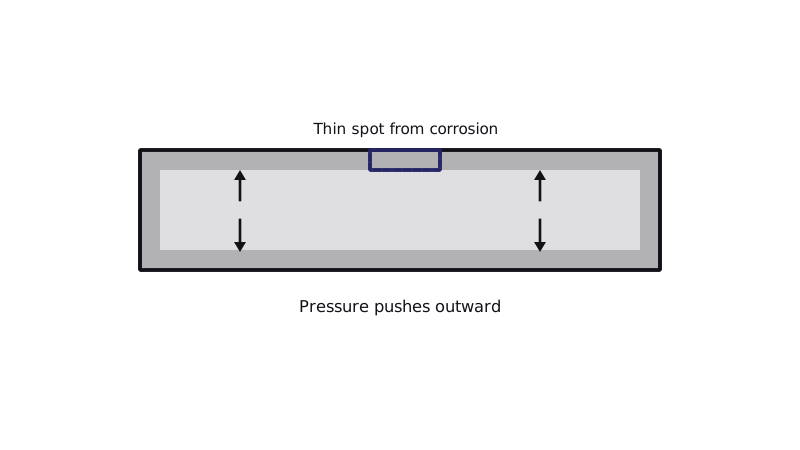
A pipe bursts when internal pressure, or a force from outside, is more than the wall can carry. Common culprits are high water pressure, age and corrosion, shifting ground and, in colder spots, freezing. If a pipe is already giving way, go first to the main shutoff valve and the leak plumber page.
What is the single most common reason for a burst?
Worn pipe under steady pressure causes more bursts than anything else. A pipe corroded or thinned on its inner or outer surface will fail at its weakest point even at normal pressure, and the failure often looks sudden. The pipe was dying for years; the burst was just the last step.
Water pressure matters because it never rests. The California Plumbing Code puts a limit of 80 psi on pressure at fixtures (section 608.2), and some homes may receive more than that from the street unless a pressure regulator holds it down. When the regulator fails, old fittings and supply lines take the full street pressure.
The number itself is not what to memorize. Instead, measure it with a cheap gauge fitted to an outside spigot. A needle above 80 means the regulator needs attention; the steps appear in the guide to setting a pressure regulator.
Is age and corrosion behind bursts in Temecula houses?
Yes. Older plumbing is the main reason. Homes in the Rancho California tracts, built from the late 1960s onward, may have copper that can develop pinholes, and homes of that age may also contain polybutylene or galvanized lines elsewhere in the system. Hard water and chemistry speed the wear, and some leaks start from outside the pipe.
Rancho Water's reports put average hardness around 230 to 240 mg/L, roughly 13 to 14 grains per gallon, in the 2020 to 2023 reports. Scale from hard water narrows pipes, plugs valves and makes water heaters work harder. Scale does not make a pipe burst on its own, but it raises the pressure drop and wears fittings.
Pinhole leaks in copper are the quiet version. Water sprays out through a tiny hole, soaks the wall and may only show as a stain or a rising bill. A true burst is the loud version, where a crack opens along a joint or the pipe splits.
Polybutylene and galvanized lines fail differently. Polybutylene can turn brittle at fittings, whereas galvanized steel corrodes internally and chokes the flow well before it leaks. We do not say that any particular street has them, only that homes of that age can. A plumber can identify pipe by sight at the water heater or an access point.
How do I recognize a burst pipe or ceiling water damage?
Watch for stains, bubbling paint, sagging drywall and a musty smell. Running water may also be audible with every fixture off, or a bill may climb without explanation. A brown or yellow ring on the ceiling, or a drip from a light fixture, means water is above. Treat it as urgent.
If water is dripping through a ceiling, close the main valve, switch off power to that area at the breaker when it is safe to do so, and keep away from wiring near the wet spot. Never stand beneath a bulging ceiling or use a light fixture that is dripping. A bucket under the drip is fine.
To check for a hidden leak, turn off every tap and watch the meter. A dial or leak indicator that keeps moving means water is getting out. By EPA figures, a typical household loses over 9,300 gallons a year to leaks, so even a small hidden one deserves attention.
During a leak detection visit, tools like acoustic listening gear or thermal cameras pinpoint the source, so the wall is cut open only as much as needed. To have a local plumber check, ask for a quote; other work we arrange appears on the home page. To judge whether a pipe has truly burst, use the guide to the warning signs of a burst.
What makes pipes burst during summer heat?
Summer failures start at the same weak points: pressure, age and corrosion. Heat contributes thermal expansion. In a closed plumbing system, each heating cycle of the water heater raises pressure, and if the expansion tank (often needed in such systems) has failed or was never installed, that pressure reaches the pipes.
Another factor is ground movement. Soil can shift, and a buried supply line or a slab pipe that rubs on concrete can wear through over time. Tree roots can also crush or invade lines in yards.
Attic and exterior lines can also suffer in the heat, because plastic pipe and fittings become stressed in a hot attic, and sun on exposed plastic degrades it.
For homes built on slabs, such as many Redhawk and Harveston houses, pipe that runs under the concrete can leak without showing anything above. The guide to slab leak detection and repair covers signs and options.
Do pipes burst in Temecula winters?
Rarely in the valley, but it can happen. Cold snaps do reach inland areas, and exposed pipes, outdoor spigots and lines in attics or exterior walls are at risk when the temperature falls below freezing for hours. The risk is higher in Aguanga, Wine Country and other rural places where winter nights run colder.
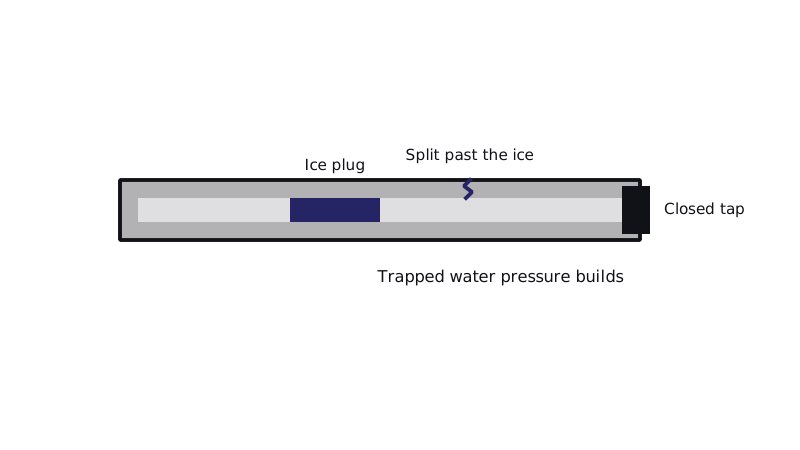
Freezing makes water expand, and a pipe splits where the ice forms or where pressure builds between the ice and a closed faucet. The split often shows only after the thaw, when water starts flowing again. That is why a burst in winter appears to happen in the morning.
Cheap protection helps: disconnect and drain hoses, cover outdoor spigots, open cabinet doors on cold nights where pipes run along exterior walls and consider insulating exposed lines. The page on burst pipe prevention covers a full checklist.
Remember that most pipe failures here are not frost related. Do not rule out a burst because it has not been cold.
Common questions
Why does freezing weather split a pipe?
As water turns to ice it expands, and the ice blocks the pipe. Pressure then builds in the water trapped between the ice and a closed tap, and the pipe wall gives way, often some distance from the ice. The leak usually shows once the ice melts and water flows again.
Is high water pressure able to burst a pipe?
Over time, yes. Pressure beyond the 80 psi code limit wears on the water heater, hoses and fittings, and a broken regulator may pass unreduced street pressure through the whole house. Read the pressure with a gauge threaded on an outdoor spigot, and have a plumber replace a regulator that cannot keep it down.
How do I stop water from a burst pipe?
Shut the main water valve, drain the lines through a low faucet, and switch the water heater off. Then phone a plumber. Keep electrical devices out of standing water. A temporary clamp may slow a small leak, but a burst section usually needs replacing.
Will insurance cover a burst pipe?
It depends on your policy, so read it or ask your agent. Many homeowners policies cover water damage that is sudden and accidental, but long-term seepage often falls outside. Take photos, stop the water, save receipts and notify your insurer without delay. We cannot give insurance advice.
How can I tell if the burst pipe is below the slab?
Look for warm spots in the floor, the sound of flowing water with every tap closed, damp carpet or flooring with no source above and a sharp rise in the bill. A leak detection visit confirms it. If a slab leak is found, the options are repair or a reroute, and the price differs.
Updated