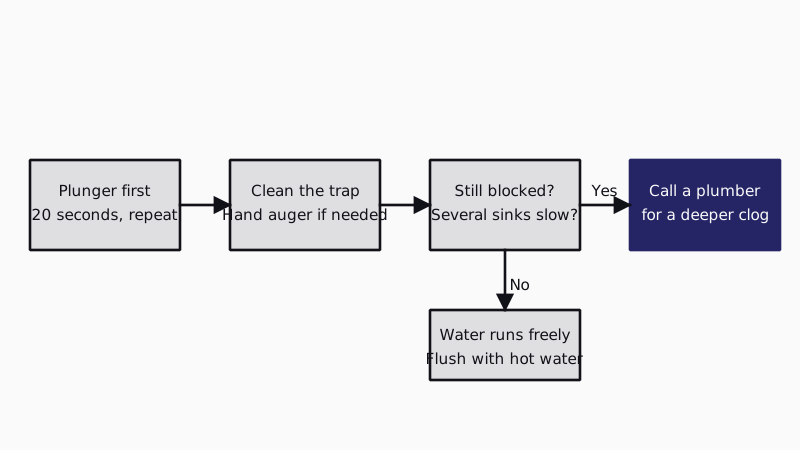
When a sink empties slowly or not at all, the blockage is nearly always close to the drain, within a few feet of it. Kitchens collect grease and food; bathrooms collect hair and soap. Work through the cheap, gentle steps in order, beginning with a plunger and moving on to the trap. If several fixtures back up at once, the clog lies further along the line and falls under the drain and clog service. The rest of this page deals only with the sink, one step at a time.
What makes a sink drain clog?
A clog forms when material gathers faster than water can carry it off. In a kitchen the culprits are grease, starch, coffee grounds and food scraps; in a bathroom, hair, toothpaste and soap scum that wrap around the stopper and the pipe wall. As the deposit thickens, the pipe gets tighter, so flow first drops and finally ceases.
Typical causes by room:
- Kitchen sink. Cooked grease cools and coats the pipe; rice and pasta swell; fibrous peels tangle.
- Bathroom sink. Hair snags on the pivot rod of the pop-up stopper and in the trap.
- Shower drain. Hair and soap form a mat just under the strainer, so a clogged shower drain often calls for the same tools.
- Old pipe. Rough, scaled pipe snags debris. Mineral scale in an older line shrinks the opening.
If water drains slowly yet nothing seems blocked, see kitchen sink not draining but not clogged for venting and other causes.
How do I open the trap or use an auger?
Set a bucket beneath the U-shaped trap, unscrew the slip nuts by hand or with pliers, lower the trap, empty it, clean it and look up into the wall pipe. Refit it with the washers seated and watch for leaks. If the blockage lies beyond the trap, use a small hand auger, pushed into the wall pipe while you turn it.
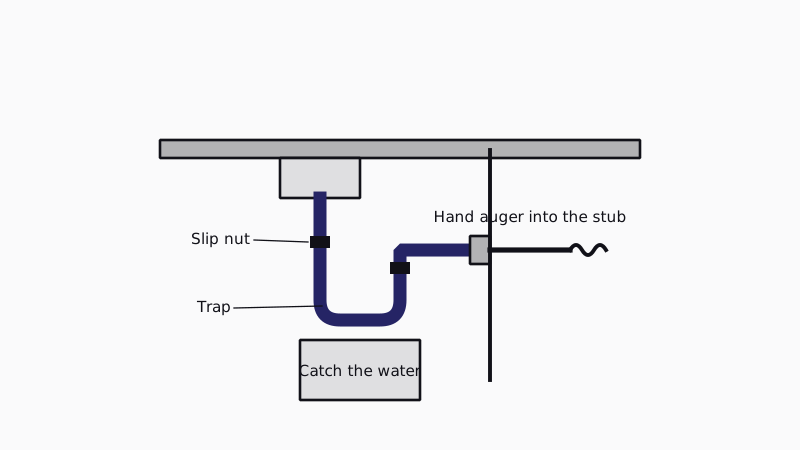
The order of work:
- Empty the cabinet and set the bucket in place.
- Loosen both nuts on the trap and ease it down.
- Empty and rinse the trap; scrape out any slime.
- Push the auger into the drain stub in the wall a few inches at a time, turning it as it goes.
- Reassemble, run water for a minute and watch every joint.
Keep your hand out of a garbage disposal at all times. If your kitchen sink has one, cut the power first, and follow the guide on clearing a disposal drain.
What is the first thing to try on a blocked sink?
Use a cup plunger before reaching for chemicals. Add water until the plunger cup is covered, stop up the overflow opening and the other bowl's drain with a damp rag, then plunge in firm, steady strokes for 20 seconds. Do this several times. Once the water drops, rinse the drain through with hot water from the tap.
A few notes:
- Choose a flat-bottomed cup plunger; a toilet flange plunger is the wrong type here.
- With a double kitchen sink, plug the second drain tightly.
- Check the flow after plunging before you try anything else.
- Put on gloves. The water is dirty.
Before escalating, lift the stopper out of a bathroom sink and remove the hair you can see. Many bathroom clogs sit on the stopper rod and nowhere else. Our guides for a bathroom sink and a kitchen sink show the parts.
When does a sink clog need a plumber?
Hire a plumber if the plunger and trap do not clear it, if more than one fixture drains slowly, if other drains gurgle, if the clog returns within days, or if sewage odors appear. Such signs suggest a branch or main-line problem beyond reach of a hand tool used at the sink.
A plumber uses a drum auger or a camera to locate and clear the blockage and check for damage, which is commonly called drain cleaning. If tree roots, a broken pipe or a sag in the line turn up, ask for the findings in writing. For rough pricing, see the toilet and drain clearing cost page.
Send a request through the quote page, or go to the Temecula Pipe and Repair home page, and say which fixtures are slow, how long this has been going on and whether you used a chemical cleaner.
Are chemical drain cleaners effective and safe?
Sometimes they work, but they are a poor first choice. Caustic cleaners burn skin and eyes, can harm certain pipes and finishes, and leave chemical water standing that endangers whoever opens the trap next. Never combine different products. Clearing the clog mechanically is safer and usually less messy.
When a chemical cleaner has failed and the sink stays blocked, tell the plumber before the trap is opened, since the water may still be caustic. Gloves and eye protection are needed if you must reach into it.
To prevent repeats, wipe pans clean into the trash before washing, fit a drain strainer, and run hot tap water down the kitchen drain after each use. Flushing with very hot water monthly can help, though it cannot clear a solid block.
In a valley where the water runs very hard, scale can coat pipes over the years. Rancho Water's own reports put average hardness around 230 to 240 mg/L, roughly 13 to 14 grains per gallon, in the 2020 to 2023 reports, so older sink lines may narrow with mineral buildup.
Common questions
How long does it take to clear a sink drain?
A plain trap-and-auger job can be over in under an hour. A deeper clog, a main line or a pipe that needs repair takes longer, and a camera inspection adds more time. The plumber can give a firmer estimate after viewing the fixture and asking where else water backs up.
Which questions help when hiring someone to clean a drain?
Learn whether the price covers a single drain or the whole line, if a camera look is included, what happens if the clog comes back and whether chemical cleaners will be avoided. Also get the contractor license number and verify it online with the state.
Do I need to be home while the drain is cleared?
Generally an adult should be present to open the sink, the cabinet and, for a deeper clog, a cleanout or the outdoor area. When nobody can be there, mention it on the request so access can be sorted out ahead of time.
Why is my sink slow again after it was cleared?
A slow return usually means the clog was only partly cleared, or that grease, hair and scale are building up again at the same spot. Scraped traps and strainers help, but a camera inspection can show whether the pipe is rough, cracked or sagging and needs repair rather than another snaking.
Updated