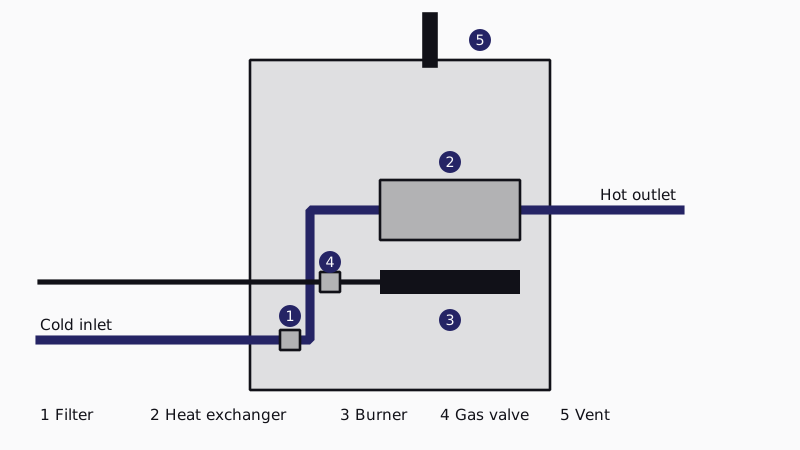
Begin an instant water heater repair with the symptom. A unit that gives lukewarm water, cuts out mid-shower or shows an error code is nearly always dealing with scale, a flow problem, a failed sensor or igniter, or a blocked vent. Many of these are fixable without replacing the unit. The wider set of heater problems sits under water heater repair.
How does an instant water heater differ from a tank?
No hot water is stored. Opening a tap lets a flow sensor detect moving water, a burner or element switches on, and the water is heated in a heat exchanger as it passes. Closing the tap switches the heater off. That is why the faults feel different: a tank runs out slowly, while a tankless unit either works or throws a fault.
Two consequences follow. First, a tankless unit will not ignite below a minimum flow, so a tap opened only slightly can deliver cold water. Second, the heat exchanger is a narrow passage, so scale or debris there matters far more than it does in a tank. Gas models also need a clear vent and gas supply, and electric models need a large dedicated circuit. For a comparison of the two designs, see tank versus tankless.
What causes an instant water heater to give cold or lukewarm water?
The common causes are a flow below the minimum, a scaled heat exchanger, a cold-water crossover in the plumbing, a blocked inlet filter, or a failed sensor. A crossover happens when a mixing valve or single-handle faucet somewhere lets cold water into the hot line, so the unit sees less hot demand than it can meet.
A sensible order of checks:
- Open one hot tap fully. If the water heats, the problem is low flow at another fixture, such as a worn aerator.
- Read any error code on the screen and note it.
- Check the inlet filter, usually behind a small cap on the cold line, for grit.
- Turn off the other taps. Two showers at once can exceed the unit's capacity.
- If the problem only appears at one faucet, suspect that faucet's cartridge.
If cold water appears briefly after you turn the tap off and on, that is the known "cold sandwich" of tankless systems and is normal. A recirculation pump and buffer tank can reduce it.
How do you read an error code?
Each manufacturer keeps its own list, so a code on the display has meaning only in your model's own manual. Common themes include ignition failure, flame loss, overheat, flow sensor fault, exhaust blockage and temperature sensor fault. Note the code, the model number on the unit's label, and what the unit was doing when the fault appeared.
Many units can be reset by cutting the power for a minute and restoring it, which clears a transient fault. If the same code returns, the fault is real. A repeating ignition code on a gas unit can mean no gas, a blocked burner, a dirty flame rod or a vent problem. A repeating overheat code often follows scale. Searching the model and code against the maker's own support page is better than a generic list, and a plumber will usually ask for the same two details.
For an electric model, Rheem electric tankless repair walks through that type in more detail.
Does hard water damage instant water heaters?
Yes, and faster than tanks, because the heat exchanger channels are narrow. Rancho California Water District's own reports put average hardness around 230 to 240 mg/L, roughly 13 to 14 grains per gallon, in the 2020 to 2023 reports. That is very hard water. Scale forms on hot surfaces, so a tankless unit in this area benefits from regular descaling.
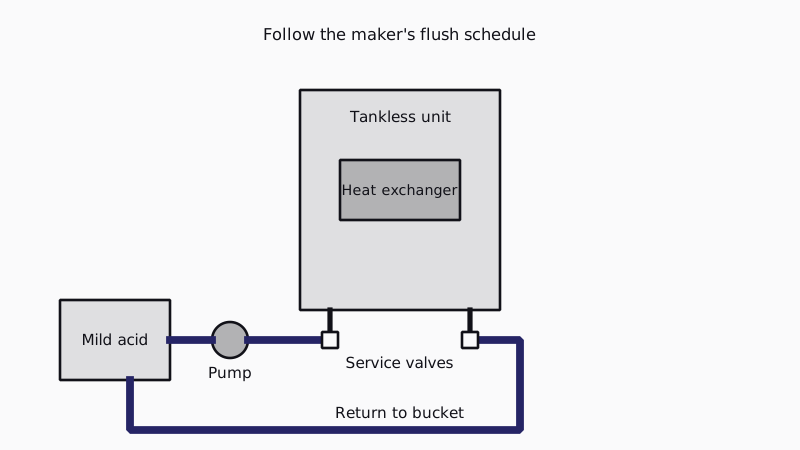
To descale, a mild acid, often white vinegar, is circulated through the heat exchanger using the unit's service valves and a small pump, following the manufacturer's instructions. Many makers sell a flush kit and specify an interval, so follow the manual and not a rule of thumb. Neglect leads to the symptoms above: lukewarm output, overheating, loud popping and codes. Some units void the warranty if they are never flushed, so keep records.
A water softener or scale inhibitor upstream protects the whole system. Your own water report is the place to check, because Eastern Municipal Water District supplies some addresses and private wells supply others. See preventing hard water scale.
What can you try yourself, and what is for a plumber?
You can reset power, clean the inlet filter, clear aerators, read the display and confirm for yourself that the gas valve stands open. Leave alone a gas unit's burner compartment, gas pressure, the vent and the internal wiring of an electric unit. Gas appliance work and permit-needing replacements are for a contractor.
If gas is detected, leave the house and call SoCalGas at 1-800-427-2200 once outdoors, plus 911 if you feel in danger. Do not flip any switch, and relight nothing. For carbon monoxide, a working CO alarm in the home near the sleeping area and the unit is the safeguard, and any unit that has sooted up or smells of exhaust should be turned off until a plumber has looked.
A permit is generally needed to replace a water heater. Addresses in Temecula go through Building and Safety at City of Temecula, with the plumber usually filing. Unincorporated parcels in San Diego County or Riverside County deal with those counties instead.
When does replacing beat repairing?
Replacement is the better choice if the heat exchanger is dead, scale damage keeps recurring, parts are discontinued, or the repair bill would approach the price of a new unit. A heat exchanger is the heart of the heater and is often the costliest part. Units that have never been flushed in hard water tend to reach this point sooner.
Get both numbers on paper from the plumber, repair and replace, along with what the new unit's venting and gas line would need. A tankless replacement may need an upsized gas line or fresh venting, which alters the bill. The installation side is covered in tankless water heater installation cost, and the fault-finding for the tank type is in no hot water.
Common questions
Why does a tankless heater stop partway through a shower?
Typical causes are that the flow dropped below the minimum, a second tap opened and exceeded capacity, the heat exchanger overheated from scale, or a sensor tripped. Check for an error code, clean the inlet filter, and note whether it happens at one fixture or all of them. A repeated cutout with the same code points to a part or scale.
Is an instant water heater the same as a tankless one?
In everyday use, yes. People say instant, on-demand and tankless for the same idea: heating water as it flows, with no stored volume. A different thing is a small point-of-use heater under a sink, which is also instant but smaller. The faults and fixes here apply to whole-house tankless units and most small ones.
How often should an instant heater be flushed?
Follow the maker's schedule in the manual, because it differs by model and water hardness. In hard water areas, it is often more frequent than the minimum. If your manual gives a range, take the shorter end when the supply is very hard, and keep a note of dates for the warranty.
Can I repair the unit myself if I find the part?
Replacing a sensor, igniter or filter can look easy, but on a gas unit the burner compartment, venting and gas train are for a contractor. On electric units, internal wiring carries high current. A small task like a filter or flush is fair game if you feel at ease doing it. Anything beyond that is cheaper to leave to a plumber than to learn.
Who can look at my unit?
Enter the model, the code and the symptom on the quote page. We forward the request to a local plumbing business, one of the businesses that pay us a fee, and it gives you the price and the visit time. The more precise your description, the more likely the first visit carries the right part.
The rest of our guides start from plumber across Temecula.
Updated